Chemical processing plants often handle liquids that can be highly corrosive to conventional storage materials. Acids, alkalis, process chemicals, and wastewater may gradually attack tanks, piping, and other equipment if the material is not suitable for the operating environment. This is why FRP tanks for chemical processing plants are widely considered for storage and process applications where corrosion resistance is an important requirement.
Fiber Reinforced Plastic (FRP) combines resin with fiberglass reinforcement to create a structure that is lightweight, strong, and resistant to many corrosive substances. However, choosing an FRP tank should not be based on tank capacity alone. Chemical concentration, temperature, resin system, operating conditions, and tank configuration all need to be evaluated before the tank is manufactured.
Also Read: What Are FRP Tanks? Types, Benefits, and Common Applications
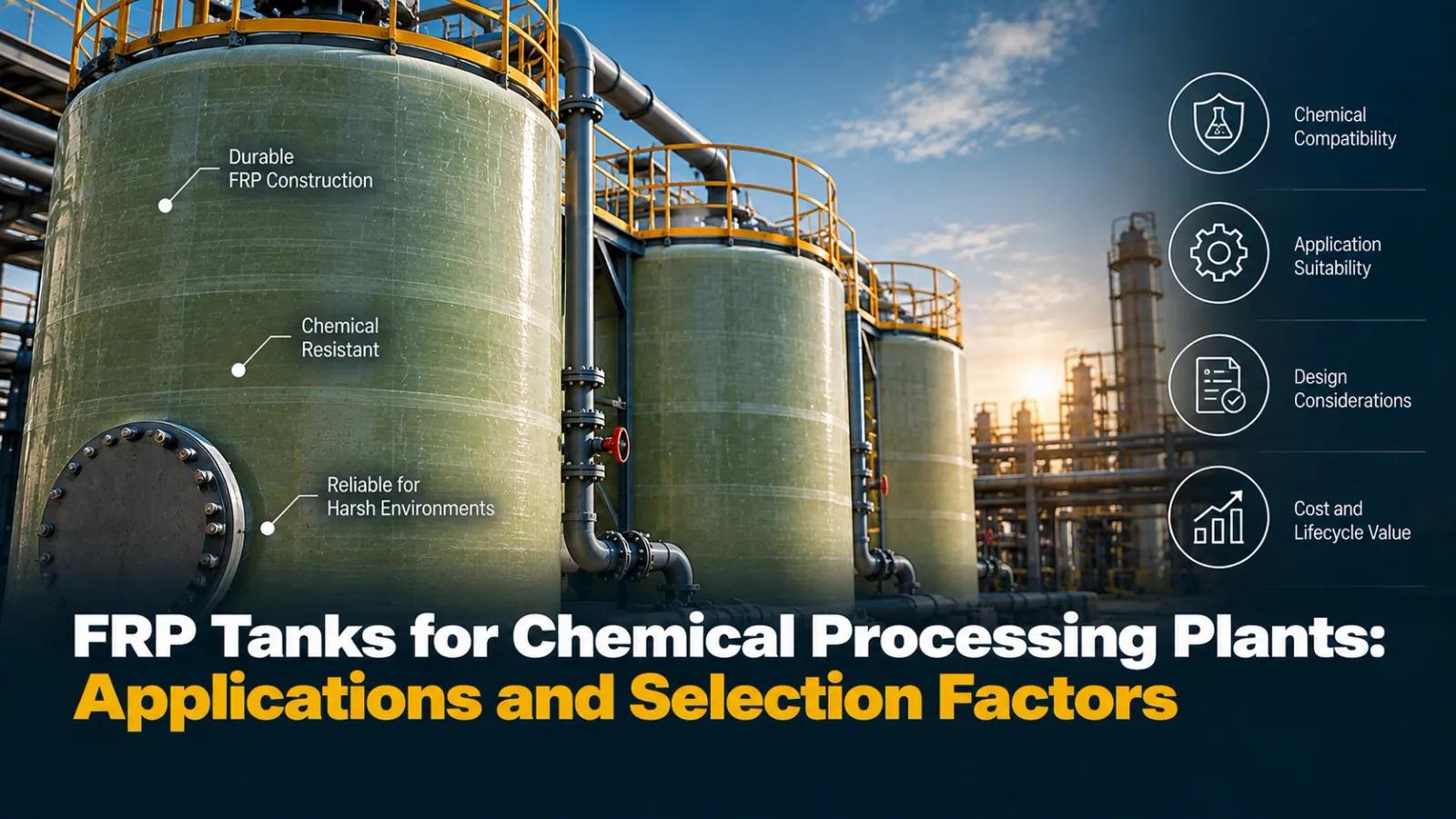
Chemical processing facilities may require tanks for raw material storage, chemical preparation, mixing, reaction processes, intermediate storage, or wastewater handling. Compared with materials that may require additional corrosion protection, FRP can be engineered with a corrosion resistant laminate suited to particular operating conditions. GAJA's Fiber force® FRP Tank is designed for applications including chemical manufacturing, chemical processing, water treatment, pharmaceutical, pulp and paper, and mining.
Other advantages of FRP tanks include their relatively low weight, high tensile strength, corrosion resistance, and ability to accommodate large storage requirements. These characteristics make FRP particularly useful in areas where equipment can be continuously exposed to chemicals or corrosive environments.
The role of an FRP tank can vary considerably from one facility to another. Some common applications include:
For example, a tank storing a concentrated acid may have very different material requirements from a tank used for diluted chemical wastewater. This is why an FRP tank should be treated as an engineered system, rather than simply selecting a standard tank based on diameter and volume.
Selecting the right FRP tank begins with understanding its actual operating conditions.
The chemical being stored or processed is one of the first considerations. The compatibility of the resin system can change depending on whether the tank contains an acid, alkali, solvent, or another process liquid. Chemical concentration also matters. Two tanks storing the same chemical at different concentrations may require different material specifications.
Temperature can influence the performance of the resin and corrosion barrier. A material that performs well at ambient temperature may not provide the same performance when exposed to elevated temperatures. Chemical type, concentration, and temperature therefore need to be evaluated together.
The resin system plays an important role in the chemical resistance of an FRP tank. Polyester and vinyl ester resin systems, for example, can be selected according to the required operating environment. Instead of choosing resin based only on price, project teams should consider chemical compatibility, operating temperature, expected service conditions, and the required tank performance.
This subject can be explored further in How to Select Resin for an FRP Chemical Storage Tank?
Chemical processing plants can require anything from relatively small process tanks to very large storage vessels. GAJA states that its Fiber force® FRP Tank can be engineered for significant capacities of up to 2,000 m³. Tank diameter, height, nozzle arrangement, access points, supports, and other details should therefore be determined based on project requirements rather than capacity alone.
Standards can also form part of the design specification. GAJA states that Fiber force® FRP Tank specifications are developed to international standards including ASME RTP-1 and ASTM, with tanks manufactured using a filament winding system. ASME RTP-1 covers stationary reinforced thermoset plastic corrosion resistant vessels intended for storage, accumulation, or processing under defined pressure conditions.
For project teams that need a deeper understanding of this subject, see ASME RTP-1 for FRP Tanks: What Project Teams Should Know?
Technical specifications become more meaningful when they are supported by actual industrial experience. GAJA has worked on FRP tank projects for several industrial facilities in Indonesia. Its project portfolio includes the construction of FRP tanks for various requirements at the Matindok Gas Plant, as well as the design, engineering, and fabrication of FRP tanks for a Copper Smelter Plant.
GAJA has also manufactured an FRP tank for a PAC water treatment plant for PT Pacinesia Chemical Industry. These projects demonstrate that FRP tanks can be applied across different industrial environments rather than being limited to general purpose chemical storage.
FRP is not automatically the best material for every application. Steel, HDPE, and other tank materials each have characteristics that may be appropriate under different process conditions. For chemical plants, the decision should consider chemical resistance, temperature, mechanical requirements, installation conditions, maintenance expectations, and lifecycle requirements.
Project teams comparing different materials can also review FRP Tank vs Steel and HDPE Tank: Which Is Better for Your Application? The objective should be to select a tank system that matches the actual process rather than choosing a material based on one advantage alone.
For demanding chemical applications, an FRP tank manufacturer should be able to do more than fabricate a vessel according to basic dimensions. Consider whether the manufacturer can support:
GAJA provides design planning, manufacturing, customization, installation, and support for its FRP tank solutions. The company also manufactures a wider range of industrial FRP products for chemical processing and other demanding applications.
When planning a new chemical storage or processing system, providing detailed information about the chemical, concentration, temperature, required volume, and operating conditions will help engineers determine a more appropriate tank specification. For project requirements or custom FRP tank specifications, project teams can contact GAJA to discuss the application and required operating conditions before moving into the design and manufacturing stage.
The service life of an FRP tank depends on chemical exposure, operating temperature, resin system, and maintenance practices. In properly designed systems, FRP tanks can operate for many years in continuous industrial service, but actual lifespan should always be evaluated based on specific process conditions.
Yes, FRP tanks can generally be repaired using composite repair techniques. The repair method depends on the type and extent of damage, and should be performed by qualified technicians to ensure structural integrity and chemical resistance are maintained.
FRP tanks can be designed for outdoor use, including exposure to UV radiation, humidity, and temperature fluctuations. In many cases, additional UV resistant surface protection or coatings are applied to improve long term durability.
FRP tanks typically require periodic inspection rather than intensive maintenance. Inspections may include checking for surface wear, structural integrity, nozzle conditions, and signs of chemical attack. Maintenance frequency depends on operating conditions and chemical exposure.
Yes, FRP tanks can be customized for complex process requirements, including multi chemical storage, batch mixing, and specialized internal configurations. Design customization is usually determined during the engineering phase based on process flow and chemical compatibility requirements.
30 Sept 2026
Learn how FRP grating is used in chemical plants, including applications, corrosion resistance, load capacity, resin selection, molded vs pultruded grating, and key selection factors.
Read More →
30 Sept 2026
FRP tanks for water and wastewater treatment plants offer corrosion resistance, durability, and customizable design for chemical storage, dosing, and industrial effluent applications.
Read More →
30 Sept 2026
FRP chemical storage tanks offer corrosion-resistant solutions for industrial environments handling acids, alkalis, and aggressive chemicals.
Read More →