FRP chemical storage tanks can provide a corrosion-resistant solution that can be engineered according to the chemical, concentration, temperature, and service requirements of a project. Fiber Reinforced Plastic (FRP) combines fiberglass reinforcement with a thermosetting resin system. Unlike selecting a storage tank based only on volume, an FRP tank for corrosive service needs to be designed around the actual process conditions. The resin, corrosion barrier, structural laminate, tank configuration, and operating environment all influence how the tank should be manufactured.
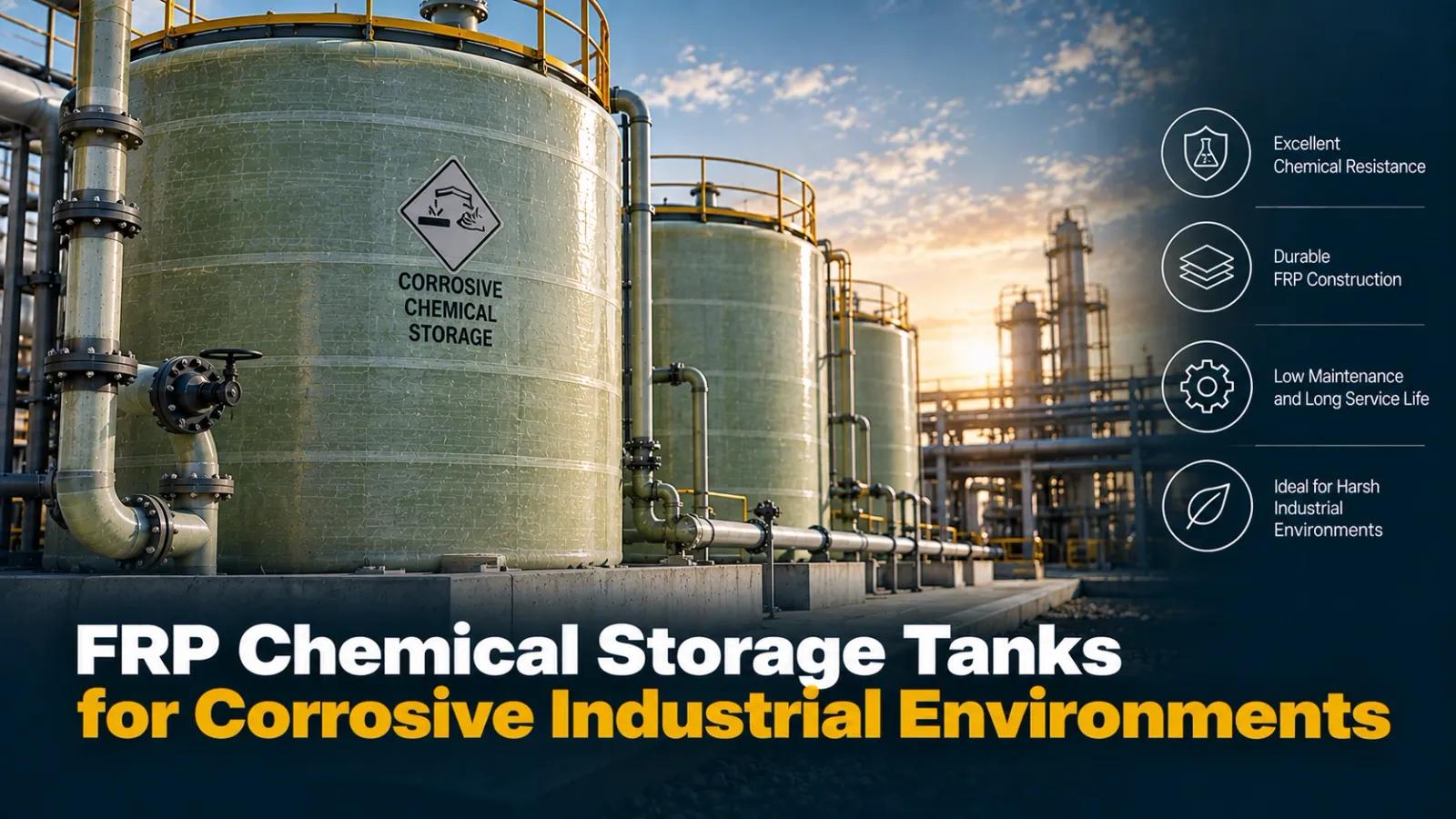
Industrial corrosion does not occur under one universal condition. A storage tank may be exposed internally to aggressive chemicals while also facing humidity, weather, chemical vapors, or other environmental factors externally. Corrosive conditions are commonly encountered in industries such as:
In these environments, corrosion can affect equipment reliability and increase inspection, repair, and maintenance requirements. FRP provides an advantage because its material system can be engineered specifically for chemical service. However, this does not mean one FRP specification will work for every chemical environment.
The chemical performance of an FRP tank largely depends on its resin system and laminate construction. An FRP chemical tank generally includes a corrosion-resistant inner section designed to provide protection against the stored liquid, while additional fiberglass-reinforced layers provide the structural strength required by the vessel.
This distinction is important. Increasing the thickness of an FRP tank alone does not necessarily solve a chemical compatibility problem. The appropriate material system should first be determined based on the chemicals and operating conditions involved. GAJA's Fiber force® FRP Tank is intended for industrial chemical storage and processing applications and can be customized based on specific project requirements.
Several operating parameters should be reviewed before specifying an FRP chemical storage tank.
The first consideration is the actual substance that will be stored. Acids, alkalis, salts, solvents, and other process chemicals can interact differently with resin systems. Project teams should provide the exact chemical rather than using a broad description such as "acid" or "chemical liquid."
Concentration can significantly affect chemical compatibility. For example, a tank intended for a diluted chemical solution may require different specifications from a tank continuously exposed to a highly concentrated solution. Chemical type and concentration should therefore always be evaluated together.
Temperature is another critical factor because chemical resistance can change as operating temperatures increase. Project teams should identify both normal operating temperature and potential maximum temperature instead of evaluating the tank based only on ambient conditions.
Resin selection is one of the most important decisions in an FRP chemical tank. Different polyester and vinyl ester resin systems provide different performance characteristics. The correct choice depends on chemical exposure, concentration, temperature, and expected service conditions. For a more detailed discussion, see How to Select Resin for an FRP Chemical Storage Tank?
Chemical storage requirements can range from relatively small process vessels to large industrial storage tanks. Tank diameter, height, nozzle arrangement, manholes, supports, connections, access requirements, and installation conditions should all be incorporated into the design. GAJA states that its Fiber force® FRP Tank can be engineered for capacities of up to 2,000 m³, depending on project requirements.
Practical industrial experience is important when evaluating equipment for corrosive service. GAJA's industrial project portfolio includes the design, engineering, and fabrication of FRP tanks for a Copper Smelter Plant. Smelting and mineral processing facilities can involve demanding operating environments where corrosion resistance is an important material consideration.
GAJA has also constructed FRP tanks for various requirements at the Matindok Gas Plant and manufactured an FRP tank for a PAC water treatment plant commissioned by PT Pacinesia Chemical Industry.
Beyond tanks, GAJA has supplied FRP pipe for acid line piping for the Merdeka Tsingshan Nickel Smelter project in Morowali. These examples demonstrate how FRP products can be integrated into industrial systems where chemical exposure and corrosion resistance are important engineering considerations.
FRP is not automatically the correct solution for every chemical storage application. Steel provides significant mechanical strength but may require coatings, linings, or other corrosion protection depending on the stored chemical. HDPE offers chemical resistance in many services but has different temperature, stiffness, and structural characteristics. FRP provides another option because engineers can modify the resin system, corrosion barrier, laminate construction, and tank configuration according to service requirements.
A broader material comparison is discussed in FRP Tank vs Steel and HDPE Tank: Which Is Better for Your Application?. Rather than asking which material is universally better, project teams should determine which material best matches the actual chemical and operating environment.
A reliable chemical storage tank begins with accurate process information. Before requesting a quotation, project teams should ideally prepare information such as:
For projects requiring specific engineering standards, ASME RTP-1 for FRP Tanks: What Project Teams Should Know? can also provide useful context during specification planning. The manufacturer should then be capable of translating these process requirements into the appropriate resin system, laminate design, tank dimensions, and configuration.
As an Indonesian FRP engineering and manufacturing company, GAJA provides design planning, manufacturing, customization, installation, and support across a range of industrial FRP products.
For chemical storage systems operating in corrosive industrial environments, project teams can contact GAJA to discuss the chemical conditions, operating parameters, and customized FRP tank requirements before moving into detailed design and manufacturing.
The service life of an FRP tank depends on chemical exposure, temperature, resin system, and maintenance practices. In properly designed applications, FRP tanks can operate for many years in corrosive environments, often outperforming conventional materials in chemical resistance.
Yes, but with limitations. FRP tanks can be engineered for elevated temperatures depending on the resin system used. However, each resin has a maximum service temperature, so proper selection is critical to avoid premature degradation.
FRP tanks are commonly installed outdoors. They can be designed with UV-resistant surface protection and weather-resistant resin systems to withstand long-term exposure to sunlight, rain, and environmental conditions.
Yes. One advantage of FRP is that it can often be repaired using composite repair techniques. However, repair methods depend on the type and severity of damage, and should be performed by qualified technicians.
In most cases, FRP tanks already include a corrosion-resistant inner layer, so additional lining is not required. However, special chemical conditions may require specific internal barrier systems depending on the application.
30 Sept 2026
FRP tanks for chemical processing plants offer corrosion resistance, durability, and customizable design for handling acids, alkalis, and industrial chemicals
Read More →
10 Aug 2026
Learn how to select resin for an FRP chemical storage tank based on chemical compatibility, concentration, temperature, corrosion barriers, and operating conditions.
Read More →
30 Sept 2026
Learn how to select FRP grating for industrial walkways and platforms, including load capacity, support span, corrosion resistance, slip resistance, resin, and key design factors.
Read More →