ASME RTP-1 for FRP tanks provides a common framework for designing, fabricating, inspecting, testing, and documenting reinforced thermoset plastic vessels used in corrosive industrial services.
For project teams, however, specifying “ASME RTP-1” in a datasheet is not enough. The owner, consultant, contractor, and tank manufacturer must agree on the operating conditions, design loads, documentation requirements, applicable edition, and whether formal ASME certification is required.
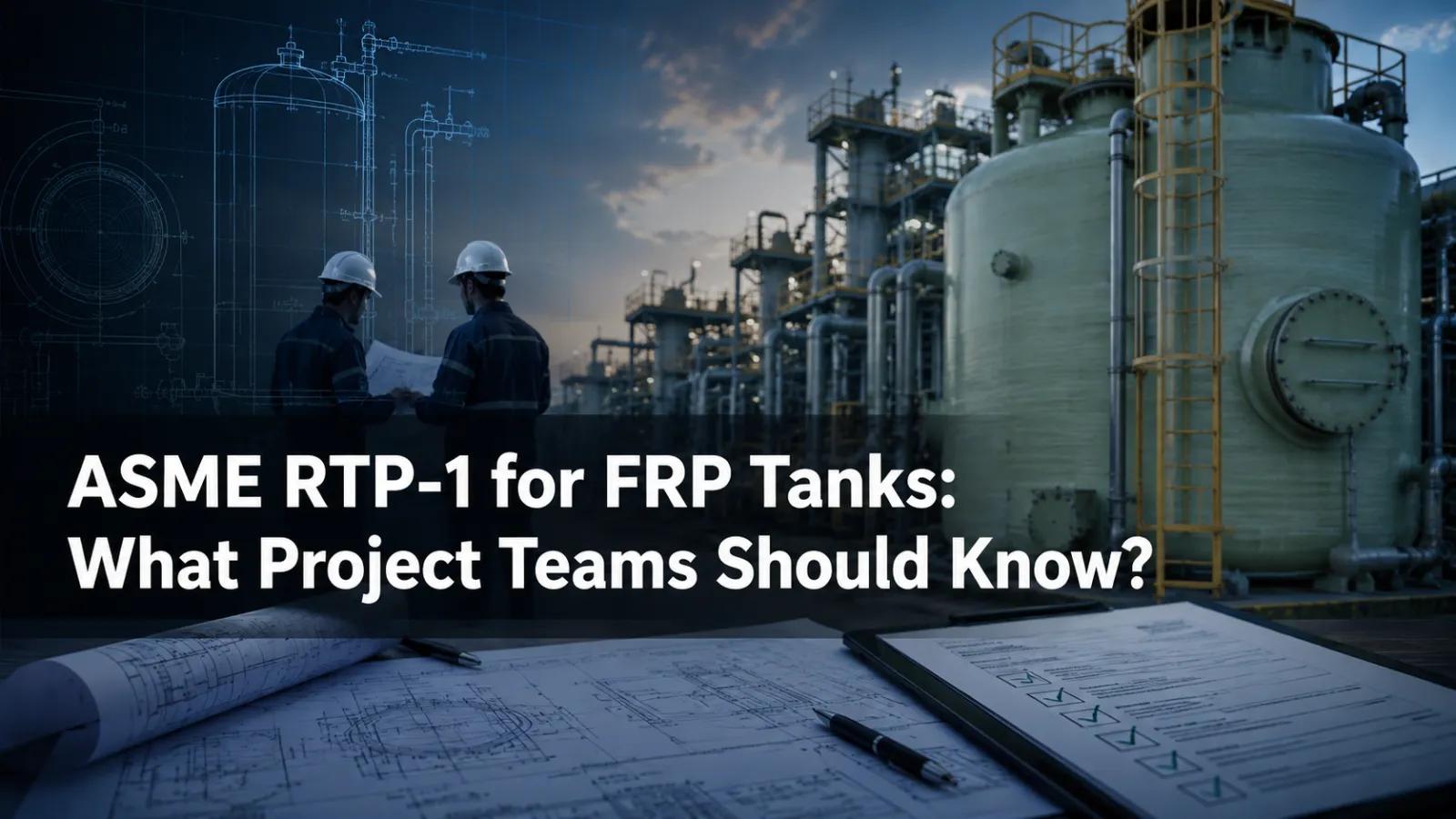
ASME RTP-1 is the standard for Reinforced Thermoset Plastic Corrosion-Resistant Equipment. It applies to stationary composite vessels used to store, accumulate, or process corrosive and other substances.
Its scope covers vessels operating at internal or external pressures not exceeding 15 psig above the hydrostatic head. Tanks outside this pressure range may require another design approach or applicable standard.
FRP is different from steel. Its performance depends on the resin, reinforcement, corrosion barrier, laminate sequence, fibre orientation, curing process, workmanship, and structural design.
ASME RTP-1 helps project teams establish consistent requirements for these elements. It reduces the risk of treating an FRP tank as a standard plastic container without considering its chemical and structural service conditions.
The standard does not replace engineering judgment. It provides rules that must be applied using accurate process information and a clearly defined design basis.
Before specifying ASME RTP-1, the project team should confirm that the equipment falls within its scope.
The standard may be relevant when the project involves a stationary FRP vessel used for:
A simple atmospheric water tank may not need the same specification as a large chemical process vessel. Conversely, a tank that appears atmospheric may still experience temporary pressure or vacuum during filling, draining, ventilation failure, or pump operation.
The design team should define both normal and abnormal operating conditions. Do not state “atmospheric” without considering a blocked vent, rapid draining, pump suction, gas generation, or connection to another pressurized system.
If the expected pressure or vacuum exceeds the scope of RTP-1, the team should review whether another ASME standard or a different vessel design is required.
RTP-1 compliance starts with complete process and mechanical data. The fabricator cannot prepare a reliable design when important operating conditions are left as “to be confirmed.”
ASME certification guidance refers to a User’s Basic Requirements Specification and a Fabricator’s Design Report. The design report includes calculations, component and joint thicknesses, and laminate sequences used to demonstrate compliance with the standard and project requirements.
The project team should provide:
Chemical compatibility should be based on the complete service environment. A resin suitable for the primary liquid may not be suitable for a cleaning solvent or temporary process contaminant.
The mechanical specification should include:
The manufacturer should also be informed of any loads transferred from connected piping. FRP nozzles should not be expected to support piping that has not been independently supported.
RTP-1 affects more than the engineering calculation. It also establishes controls for materials, personnel, fabrication procedures, inspection, and records.
Resins, curing agents, reinforcements, and other materials should be identified and inspected when received. Relevant material documentation must be controlled so that the materials used in production match the approved design.
Substituting a resin or reinforcement without engineering review may change the chemical resistance or structural performance of the vessel.
FRP fabrication depends heavily on workmanship. ASME certification guidance includes qualification controls for designers, laminators, secondary bonders, inspectors, and other personnel whose work affects product quality.
Secondary bonding is particularly important around nozzles, attachments, joints, and field assembled sections. Poor surface preparation or curing can create weak points even when the main tank laminate is properly manufactured.
Production should use the latest approved drawings, specifications, procedures, and purchase requirements. Changes must be reviewed and documented rather than implemented informally on the shop floor.
This control helps ensure that the manufactured tank matches the design reviewed by the project team.
Inspection should be planned before manufacturing begins. The purchase specification should state which documents require review, which activities require witnessing, and which records must be submitted with the completed tank.
Depending on the project scope, inspection may cover:
Hold points should be agreed upon early. Requesting an inspection after a laminate has been covered by additional layers may make proper verification difficult.
The required manufacturing record package may include approved drawings, material records, design calculations, laminate details, inspection reports, test results, repair records, and certificates required by the purchase order.
ASME’s RTP checklist states that documentation required by the standard must be organized and available during fabrication, with fabricator retention requirements included in the quality program.
This distinction should be clear in the tender and purchase order.
A tank may be designed and manufactured using RTP-1 requirements without necessarily carrying an ASME Certification Mark with the RTP Designator. ASME states that the RTP Designator identifies vessels manufactured by an ASME certified fabricator holding a valid RTP Certificate of Authorization. Certification scopes may also cover field assembly, field fabrication, and repair.
Project teams should therefore specify which of the following is required:
| Procurement wording | What it generally means |
|---|---|
Designed in accordance with ASME RTP-1 | The design and fabrication requirements reference RTP-1, subject to the agreed project scope. |
ASME RTP-certified fabricator required | The manufacturer must hold the applicable ASME authorization. |
ASME Certification Mark with RTP Designator required | The completed vessel must meet the formal ASME certification and marking requirements. |
Third party inspection required | An independent inspector reviews specified manufacturing or testing activities. |
These requirements are not interchangeable. The project team should confirm them before quotations are compared.
Before placing an FRP tank order, confirm the following items:
| Item | What the Team Should Confirm |
|---|---|
Applicable edition | State the required ASME RTP-1 edition |
Tank service | Define whether it is for storage, mixing, processing, or reaction |
Chemical data | Provide composition, concentration, density, and contaminants |
Temperature | Provide normal, design, cleaning, and upset temperatures |
Pressure and vacuum | Include credible normal and abnormal cases |
Design loads | Define wind, seismic, piping, agitator, and platform loads |
Materials | Confirm resin, reinforcement, and corrosion barrier requirements |
Inspection | Define review, witness, and hold points |
Certification | Clarify whether an ASME RTP Mark is required |
Documentation | List calculations, reports, drawings, and test records required |
At GAJA Fiberglass, we manufacture Fiber force® FRP Tanks for chemical storage, processing, mixing, and reactor applications. Our tank specifications can be developed to meet project requirements referencing international standards such as ASME RTP-1 and relevant ASTM standards. We manufacture the tanks using an advanced filament winding system and customize the dimensions, laminate construction, nozzles, and accessories based on the approved design conditions.
Before preparing the design, our team reviews the stored chemical, concentration, temperature, specific gravity, capacity, installation conditions, and external equipment loads. We also clarify the required standard edition, inspection scope, documentation, and certification level so that these requirements are reflected in the proposal.
Indonesia Head Office
Email: marketing@gajafiberglass.com
Phone: +62 (21) 4585-3491
WhatsApp: +62 811-186-7919
Australia Representative
Contact Person: Mr. Victor Bhave
Email: victor.bhave@gajafiberglass.com
Phone: +61 41 424-0017
No. It can also apply to stationary FRP vessels used for accumulation and processing within the standard’s scope.
No. Its scope is limited to internal and external pressures not exceeding 15 psig above the hydrostatic head.
No. Formal ASME certification requires an authorized fabricator and the applicable ASME Certification Mark with RTP Designator.
The resin should be selected through coordination between the project team, resin supplier, and FRP tank manufacturer using the complete chemical and temperature data.
Confirm the chemical service, concentration, temperature, density, pressure, capacity, loads, nozzles, installation location, inspection requirements, and certification level.
30 Sept 2026
FRP tanks for water and wastewater treatment plants offer corrosion resistance, durability, and customizable design for chemical storage, dosing, and industrial effluent applications.
Read More →
30 Sept 2026
FRP chemical storage tanks offer corrosion-resistant solutions for industrial environments handling acids, alkalis, and aggressive chemicals.
Read More →
30 Sept 2026
FRP tanks for mining and smelting applications offer an alternative for storing and processing corrosive liquids where conventional materials may require additional corrosion protection.
Read More →