FRP tank resin selection is one of the most important steps in designing a chemical storage tank. The selected resin determines how well the tank can resist corrosion, chemical exposure, and operating temperatures over its service life.
A resin that is suitable for water may not be compatible with concentrated acids, alkaline solutions, solvents, or oxidizing chemicals. For this reason, resin selection should be based on the exact chemical, concentration, temperature, and operating conditions rather than the initial material cost alone.
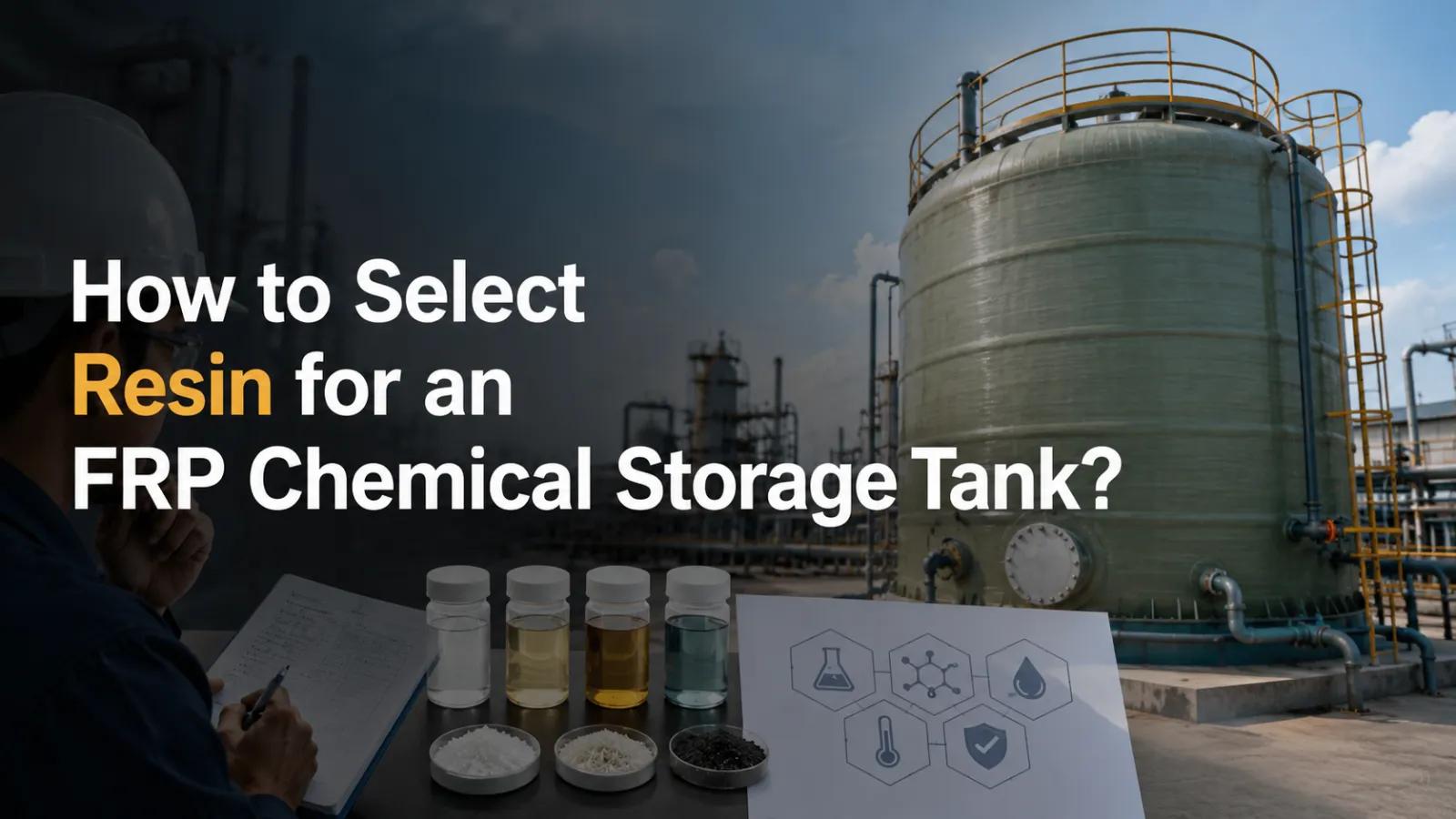
Before comparing resin types, you need to understand the operating conditions of the tank. Chemical compatibility cannot be determined from the chemical name alone because concentration, temperature, contamination, and cleaning procedures can also affect resin performance.
Start by identifying the exact chemical that will be stored. Avoid using general descriptions such as acid, solvent, or wastewater because each substance may react differently with the resin.
Provide information such as the chemical name, composition, density, contaminants, and expected storage duration.
Chemical concentration can significantly affect resin resistance. A resin suitable for a diluted solution may not withstand the same chemical at a higher concentration.
You should also consider temporary concentration changes caused by evaporation, mixing, filling, or process interruptions.
Temperature can increase the aggressiveness of chemical exposure and reduce the mechanical performance of certain resins.
Inform the manufacturer about both the normal operating temperature and the maximum possible temperature during cleaning, transfer, or process disturbances.
A mixture may behave differently from each individual chemical. Even a small amount of solvent, oxidizing agent, or contaminant can affect resin compatibility.
Provide the complete chemical composition whenever the tank will hold mixed liquids or industrial wastewater.
After identifying the chemical and operating conditions, the next step is comparing the available resin systems. Each resin type offers a different balance of chemical resistance, temperature capability, mechanical strength, and cost.
The following resin types are commonly considered for FRP chemical storage tanks.
Orthophthalic polyester is an economical resin generally used for water, non corrosive liquids, and light duty applications.
Its resistance to aggressive chemicals and elevated temperatures is limited, so it is generally not the first choice for demanding chemical storage.
Isophthalic polyester provides better chemical and temperature resistance than orthophthalic polyester.
It may be suitable for water treatment, wastewater, dilute chemicals, and other moderately corrosive environments.
Vinyl ester resin is widely used for chemical storage tanks because it provides strong resistance to many acids, alkaline solutions, salts, and industrial process liquids.
It is commonly considered for chemical processing, mining, wastewater treatment, and pulp and paper applications. However, compatibility must still be confirmed based on the exact chemical, concentration, and temperature.
Epoxy vinyl ester is selected for more demanding environments that require high chemical resistance and strong mechanical performance.
It may be suitable for aggressive chemicals, higher concentrations, or operating conditions where standard polyester resin would not provide sufficient protection.
Flame retardant resin is used when a project has specific fire safety or flame spread requirements.
Its chemical compatibility must still be checked because fire resistance does not automatically mean the resin is suitable for every stored substance.
Selecting the right resin is only one part of the tank design. The internal corrosion barrier must also be designed to protect the structural laminate from direct chemical exposure.
A properly designed corrosion barrier typically contains a high resin content and chemical resistant reinforcement.
The inner surface is the first layer in contact with the stored liquid. It is designed to reduce chemical penetration and provide a smooth protective surface.
A surface veil may be added to improve resin distribution and strengthen the chemical resistant inner layer.
The veil material should also be selected according to the chemical environment.
Behind the corrosion barrier, the structural laminate provides the strength needed to withstand liquid pressure, tank weight, wind loads, and other operating forces.
The structural layer may use a different reinforcement arrangement while remaining compatible with the selected resin system.
Some applications require additional evaluation beyond normal chemical compatibility. These conditions may influence both the resin type and the overall tank construction.
Certain solvents can penetrate resin, cause swelling, or reduce laminate strength.
For solvent storage, the resin supplier and FRP manufacturer should conduct a more detailed compatibility review.
Strong oxidizing chemicals can degrade some resin systems more rapidly than ordinary acids or alkaline solutions.
A specialized resin and corrosion barrier may be required for bleaching agents, disinfectants, or other oxidizing substances.
The cleaning liquid may be more aggressive than the chemical normally stored in the tank.
Consider the cleaning agent, concentration, temperature, frequency, and whether hot water, steam, or solvents will be used.
Projects with fire performance requirements may need flame retardant resin or additional protective features.
Chemical resistance and fire performance should be assessed together rather than separately.
A chemically compatible resin must also support the structural requirements of the tank. Resin selection should therefore be coordinated with the tank dimensions, liquid density, loading conditions, and accessories.
Larger and taller tanks experience greater hydrostatic loads. The laminate thickness and reinforcement arrangement must be designed accordingly.
A liquid with a higher specific gravity places more pressure on the tank wall than water.
The actual liquid density should be provided during the engineering stage.
Most chemical storage tanks operate near atmospheric pressure, but filling, draining, ventilation problems, or process connections can create pressure or vacuum conditions.
These conditions must be included in the design.
Large nozzles, agitators, ladders, platforms, and instruments can create concentrated loads on the tank.
Additional reinforcement may be required around these components.
The final resin selection should not rely on general assumptions. It should be verified using technical data from the resin supplier and reviewed by the FRP tank manufacturer.
Before requesting an FRP chemical tank quotation, prepare complete operating information. Accurate data allows the manufacturer to recommend the correct resin, corrosion barrier, and laminate construction.
Provide the following details:
There is no single resin that is best for every FRP chemical storage tank. Isophthalic polyester may be sufficient for water or mild chemicals, while vinyl ester or epoxy vinyl ester may be required for more aggressive environments.
The safest approach is to match the resin with the exact chemical, concentration, temperature, and process conditions.
GAJA Fiberglass provides customized FRP tank solutions for chemical storage, mixing, processing, and reactor applications. Its team can evaluate the chemical environment and recommend an appropriate resin and laminate design for the project.
Indonesia Head Office
Email: marketing@gajafiberglass.com
Phone: +62 21 4585 3491
WhatsApp: +62 811 186 7919
Australia Representative
Contact Person: Mr. Victor Bhave
Email: victor.bhave@gajafiberglass.com
Phone: +61 41 424 0017
There is no single best resin. The right choice depends on the chemical, concentration, temperature, and operating conditions.
Yes. Vinyl ester resin is commonly used for acids, alkalis, salts, wastewater, and other corrosive industrial liquids.
Yes, but mainly for water, mild chemicals, and less aggressive environments. It is generally not recommended for highly corrosive chemicals.
Yes. Higher temperatures can increase chemical attack and reduce resin performance, so both normal and maximum temperatures must be considered.
Compatibility should be checked using resin supplier data and reviewed by the FRP tank manufacturer based on the complete operating conditions.
30 Sept 2026
FRP chemical storage tanks offer corrosion-resistant solutions for industrial environments handling acids, alkalis, and aggressive chemicals.
Read More →
3 Oct 2026
Learn how FRP pipe pressure class works and how to select the right rating based on pressure, temperature, fluid, surge, and design conditions.
Read More →
30 Sept 2026
Learn how FRP grating is used in chemical plants, including applications, corrosion resistance, load capacity, resin selection, molded vs pultruded grating, and key selection factors.
Read More →