FRP grating for wastewater treatment plants provides a non metallic alternative for flooring and access structures where corrosion resistance, relatively low weight, and durability are important considerations.
Fiber Reinforced Plastic (FRP) grating combines fiberglass reinforcement with a thermosetting resin system. Unlike conventional carbon steel grating, FRP does not rust in the same way when exposed to moisture. Its resin system can also be selected according to the chemical environment.
However, choosing FRP grating for a wastewater treatment plant requires more than selecting a panel size. Load capacity, support span, chemical exposure, resin type, surface condition, and installation environment should all be evaluated.
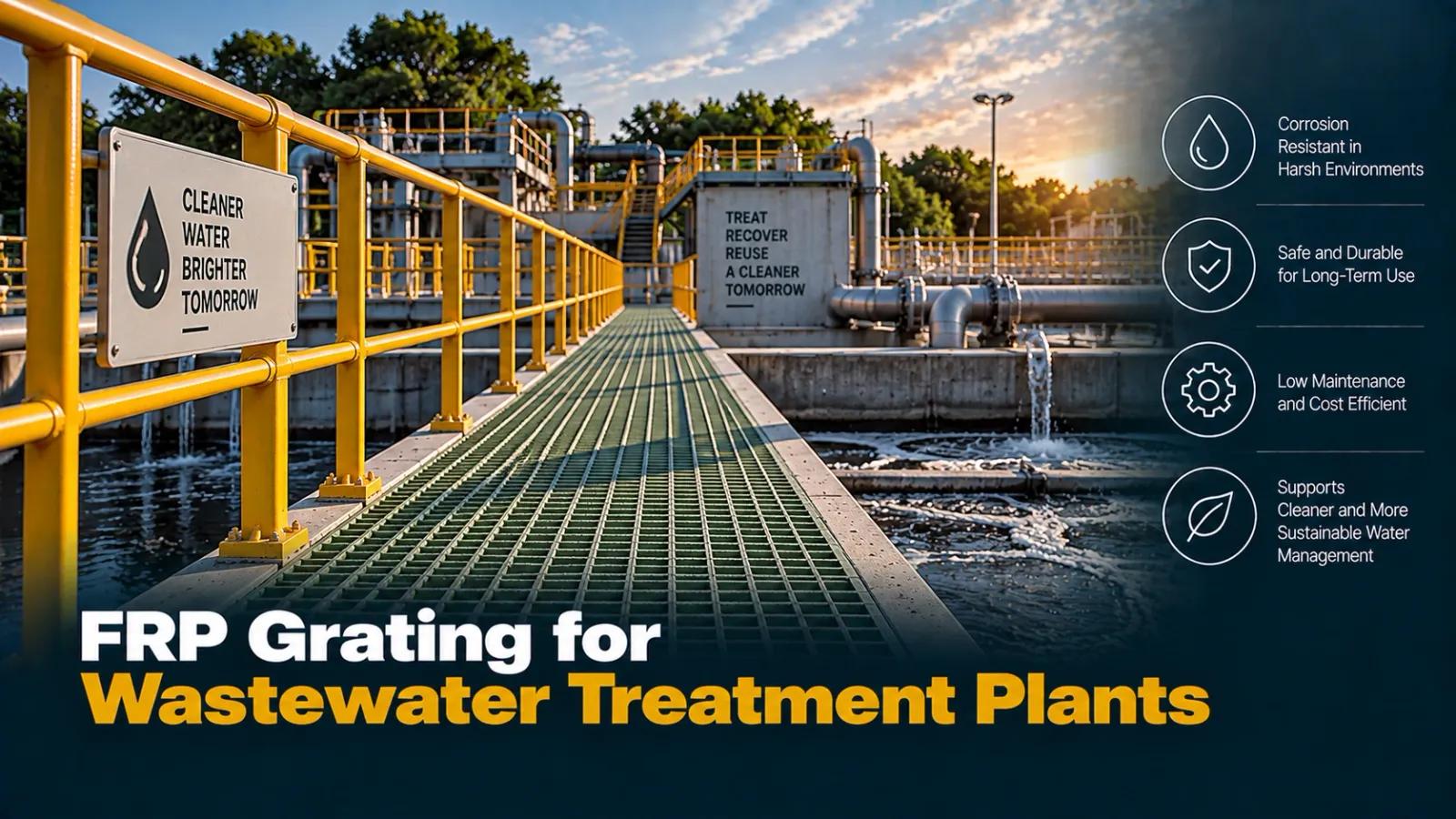
Treatment facilities require safe access around tanks, piping, pumps, treatment equipment, channels, and other process areas. Depending on the facility design, FRP grating can be considered for:
Different areas may require different grating specifications. For example, a walkway located in a general treatment area may experience mainly moisture and water exposure, while grating around chemical dosing equipment may also be exposed to acids, alkalis, or treatment chemicals. The operating environment should therefore be identified before the final grating specification is selected.
Moisture is present throughout most wastewater treatment operations. Industrial wastewater can also contain salts, acids, alkalis, chemicals, and other contaminants depending on its source. In addition, chemicals may be used during neutralization, coagulation, disinfection, and other treatment stages.
These conditions can increase corrosion concerns for metallic components. FRP provides an advantage because it is a non metallic composite material. When an appropriate resin system is used, the grating can provide resistance to many wet and chemically aggressive environments.
This can make FRP particularly relevant for areas where corrosion related inspection and maintenance are important considerations. Chemical resistance, however, is not universal. The suitability of an FRP resin should still be checked against the actual chemical, concentration, temperature, and exposure conditions.
Several characteristics should be considered when evaluating FRP grating for a treatment facility.
FRP does not experience the same rusting mechanism as carbon steel. This can be useful for walkways and platforms exposed continuously to moisture, process water, wastewater, and treatment chemicals. For areas with direct chemical exposure, the resin system should be selected according to the actual service environment.
FRP grating is generally lighter than steel grating. Lower weight can simplify handling and installation, particularly when panels need to be installed around existing tanks, elevated platforms, or treatment equipment. It can also make individual panels easier to remove when maintenance access is required.
Fiberglass reinforcement gives FRP grating structural capability while maintaining relatively low weight. However, engineers should not assume that all FRP grating panels provide the same load capacity. Panel thickness, grating construction, support span, load type, and allowable deflection all need to be evaluated.
FRP is electrically non conductive compared with conventional metal grating, which may provide an additional consideration for certain industrial environments. Specific electrical and safety requirements should still be evaluated according to the project.
Wastewater facilities often have wet walking surfaces. The grating surface should therefore be selected according to expected pedestrian traffic and site conditions. Appropriate surface configurations can help provide better footing in wet or frequently accessed areas.
Selecting FRP grating based only on panel thickness can lead to an incorrect specification. Engineers should consider:
Support span is especially important because increasing the distance between supports can increase panel deflection under load. A grating panel suitable for one walkway configuration may therefore not provide the same performance when installed over a larger unsupported span. Project teams should use manufacturer load data when determining the appropriate specification. For a more detailed explanation, see How to Read FRP Grating Load Tables.
Wastewater treatment projects may consider either molded or pultruded FRP grating depending on structural and environmental requirements. Molded grating is manufactured as an integrated grid panel and is commonly considered for wet and corrosive industrial environments.
Pultruded grating uses pultruded load bearing bars assembled into panels and can provide different structural characteristics depending on its configuration. Rather than assuming one type is always better, project teams should compare:
A detailed comparison is available in Molded vs Pultruded FRP Grating: Key Differences.
Wastewater treatment plants do not have one universal chemical environment. A municipal wastewater plant may operate under different conditions from an industrial treatment facility receiving effluent from a chemical, mining, food processing, or manufacturing plant. Before selecting the resin system, project teams should identify:
Grating around a chemical dosing tank, for example, may experience different exposure from a walkway around a final treatment stage. The specification should therefore reflect the actual installation location rather than applying the same grating throughout the entire facility without evaluation.
Steel grating remains widely used for industrial walkways and provides high structural strength. In continuously wet or corrosive areas, however, corrosion protection and ongoing maintenance may also need to be considered. FRP may offer advantages where corrosion resistance and lower weight are important. The comparison should consider:
For a more complete material comparison, see FRP Grating vs Steel Grating: Performance and Lifecycle Cost. The appropriate choice depends on the location and operating conditions rather than assuming one material is universally superior.
Experience with the broader operating environment can also be relevant when selecting an FRP manufacturer. GAJA has worked on international water and wastewater related projects involving other FRP products. Its project portfolio includes manufacturing FRP Pipe, Fittings, and Duct for the Bondi STP Ventilation project commissioned by Sydney Water, as well as FRP Ducting for the Winmalee WWT Plant Project.
These projects involved other FRP products rather than FRP Grating, so they should not be interpreted as examples of GAJA grating installations. However, they demonstrate broader experience manufacturing FRP components for water and wastewater treatment environments. GAJA also manufactures FRP Grating as part of its range of industrial FRP solutions for flooring and walkway applications.
Before requesting a quotation, project teams should ideally provide:
This information allows the grating specification to be evaluated according to the actual application rather than simply selecting a standard panel. For wastewater treatment facilities requiring corrosion resistant walkways, platforms, trench covers, or maintenance access areas, project teams can contact GAJA to discuss load requirements, chemical exposure, dimensions, and installation conditions before determining the final FRP grating specification.
FRP grating can provide corrosion resistance in wet and chemically exposed environments while remaining relatively lightweight. Suitability still depends on resin type, load, span, temperature, and chemical exposure.
Common applications include walkways, maintenance platforms, tank access areas, stair treads, trench covers, drainage areas, pump platforms, and chemical dosing areas.
It can be suitable for many chemical environments when the correct resin system is selected. The chemical, concentration, temperature, and exposure conditions should be reviewed before specification.
Molded FRP grating is commonly considered for wet and corrosive industrial environments. Its load capacity, resin system, support span, and surface configuration should still match the application.
Consider design load, support span, traffic, wastewater composition, chemical exposure, temperature, surface requirements, and installation conditions.
30 Sept 2026
FRP tanks for water and wastewater treatment plants offer corrosion resistance, durability, and customizable design for chemical storage, dosing, and industrial effluent applications.
Read More →
30 Sept 2026
Learn how FRP grating is used in chemical plants, including applications, corrosion resistance, load capacity, resin selection, molded vs pultruded grating, and key selection factors.
Read More →
30 Sept 2026
Learn how to select FRP grating for industrial walkways and platforms, including load capacity, support span, corrosion resistance, slip resistance, resin, and key design factors.
Read More →