Molded vs pultruded FRP grating is a common comparison when selecting industrial flooring, walkways, platforms, or trench covers. Both products offer corrosion resistance, low weight, and easier handling than conventional steel grating, but their structure and load performance are different.
Molded grating is generally suitable for corrosive environments, shorter support spans, and layouts with many cut outs. Pultruded grating is usually selected when greater stiffness and longer support spans are required. The right choice depends on the load, support arrangement, chemical exposure, and installation layout.
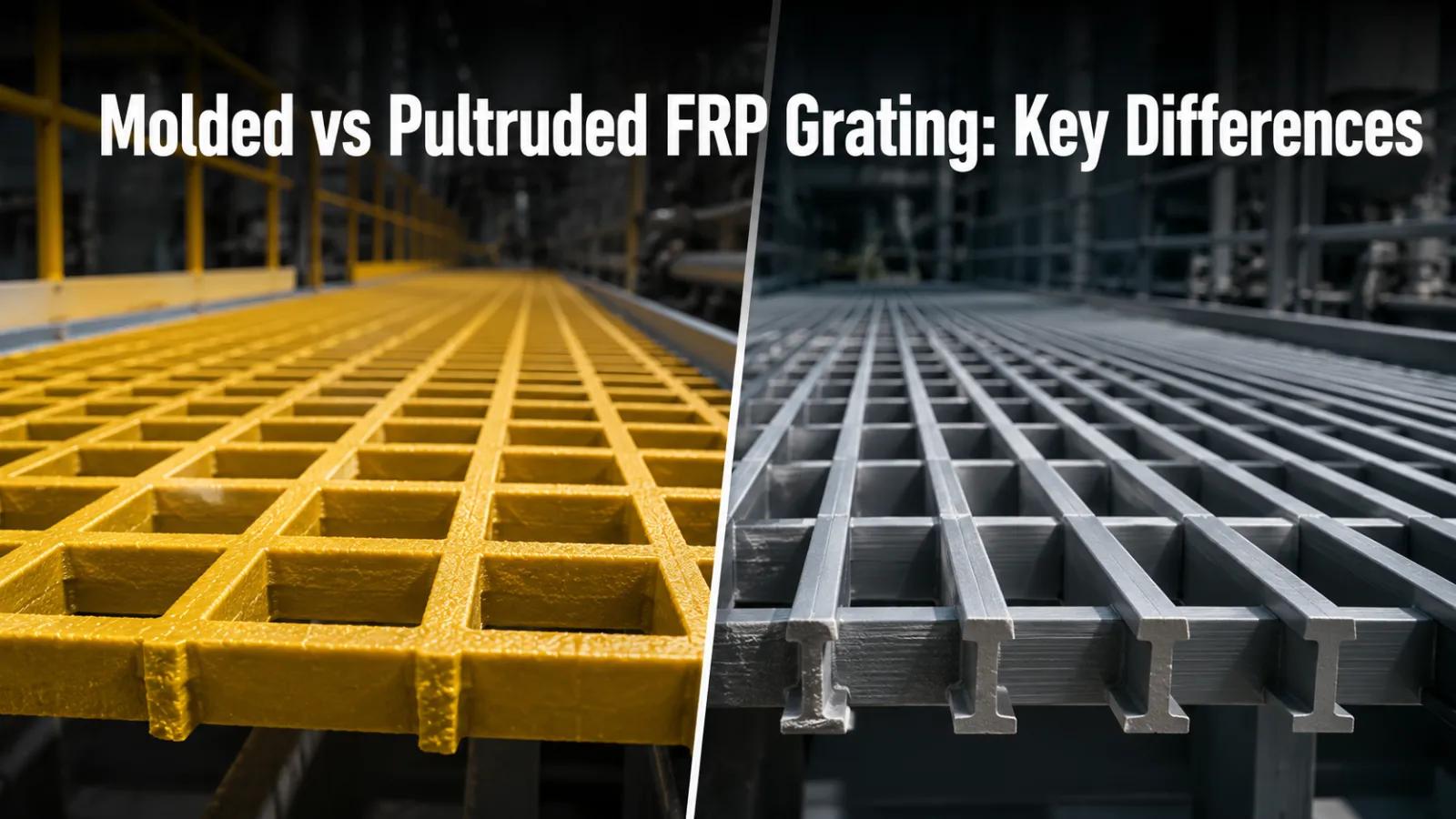
Molded and pultruded grating are both made from resin and glass fiber reinforcement. The main difference is how they are manufactured and how the reinforcement is arranged inside the finished panel.
Molded grating is produced by placing continuous glass fiber reinforcement and liquid resin into an open mould. The material is built up in layers before being cured into a one piece mesh panel.
Its reinforcement runs in both directions, allowing loads to be distributed across the panel. This bidirectional structure is useful for platforms with several access openings, pipes, or irregular cutting requirements.
Pultruded grating is assembled from parallel load bearing bars connected by cross rods. The bearing bars are manufactured by pulling continuous glass fibers through resin and then through a heated forming die.
Most of its strength runs along the bearing bar direction. Because of its higher glass fiber content, pultruded grating is generally stiffer and can span greater distances under comparable loading conditions.
The following table summarizes the main differences between molded and pultruded FRP grating.
| Comparison Factor | Molded FRP Grating | Pultruded FRP Grating |
|---|---|---|
Construction | One piece moulded mesh panel | Parallel bearing bars connected by cross rods |
Load direction | Bidirectional | Primarily in the bearing bar direction |
Stiffness | More flexible | Generally stiffer |
Support span | Commonly used for shorter spans | Often suitable for longer spans |
Resin content | Generally higher | Generally lower |
Chemical exposure | Often preferred in highly corrosive areas | Suitable when the resin system matches the environment |
Cutting flexibility | Suitable for irregular layouts and multiple cut outs | Cutting must consider bearing bar direction |
Typical use | Chemical platforms, trench covers, wet areas | Long span walkways and structured platform layouts |
These differences are general. The final grating configuration must still be checked using the manufacturer’s load table and project conditions.
It is not accurate to say that one type is always stronger. Pultruded grating is generally stiffer because its continuous glass reinforcement is concentrated in the main bearing bars. This helps it resist deflection over longer spans.
Molded grating distributes loads in two directions and provides good impact resistance. High load molded configurations are also available, so the manufacturing type alone does not determine the allowable load.
The clear distance between supports has a major effect on grating performance. Increasing the span can increase deflection even when the panel thickness and load remain the same.
Before selecting a product, the project team should confirm:
The panel and supporting frame should be evaluated as one system rather than specified separately.
Both grating types can resist moisture and corrosive environments when manufactured with a compatible resin system. However, molded grating generally contains more resin and has a one piece construction, which can provide greater protection for the glass fibers.
Pultruded grating has a higher glass content and is assembled from separate bearing bars and cross rods. Drilling, cutting, or damaging the surface can expose reinforcement, so fabricated edges should be resealed according to the manufacturer’s instructions.
For either type, resin selection should consider:
FRP should not automatically be considered compatible with every acid, alkaline solution, solvent, or process liquid.
Molded grating is often easier to use in complex layouts. Its bidirectional mesh allows panels to be cut around columns, pipes, valves, and equipment while maintaining support through the remaining grid.
Pultruded grating can also be fabricated, but the bearing bars must remain properly oriented between supports. Removing too many bearing bars or installing the panel in the wrong direction can reduce its load capacity.
Regardless of the product selected, installation should include suitable framing, hold down clips, panel connectors, and sealed cut edges. Unsupported panel edges and large openings may require additional structural support.
Choose molded FRP grating when:
Choose pultruded FRP grating when:
Neither option should be selected only by panel dimensions or price. Chemical conditions, load tables, support spans, and installation details must be reviewed first.
At GAJA Fiberglass, we manufacture Dura Gritz® FRP Grating using a moulding system that combines thermosetting resin with high strength roving yarn. Our product is therefore categorized as molded FRP grating rather than pultruded grating.
We review the expected load, support layout, chemical environment, panel dimensions, and cutting plan before confirming the product configuration. We can also support design planning, manufacturing, customization, installation, and project implementation.
Dura Gritz® is commonly used for:
Its available characteristics include corrosion resistance, lightweight handling, anti slip performance, easy cutting, and optional fire resistant specifications.
The choice between molded and pultruded FRP grating should be based on the load, support span, chemical environment, cutting plan, and installation layout.
Our team can review your project requirements and prepare a suitable Dura Gritz® molded FRP grating configuration for industrial platforms, walkways, trench covers, and chemical processing areas.
Indonesia Head Office
Email: marketing@gajafiberglass.com
Phone: +62 (21) 4585-3491
WhatsApp: +62 811-186-7919
Australia Representative
Contact Person: Mr. Victor Bhave
Email: victor.bhave@gajafiberglass.com
Phone: +61 41 424-0017
Pultruded grating is generally stiffer, but actual strength depends on the panel depth, support span, load type, and product configuration.
Molded grating is often preferred for aggressive chemical environments because of its higher resin content and one piece construction.
Molded grating is usually easier to adapt around pipes, columns, and irregular openings.
Yes, provided the panel thickness, mesh, support span, and framing are selected for the expected load.
Its primary load capacity runs along the bearing bars. Correct orientation during installation is therefore important.

13 Oct 2026
Compare FRP lining vs epoxy coating in chemical resistance, durability, thickness, installation, and cost for industrial applications.
Read More →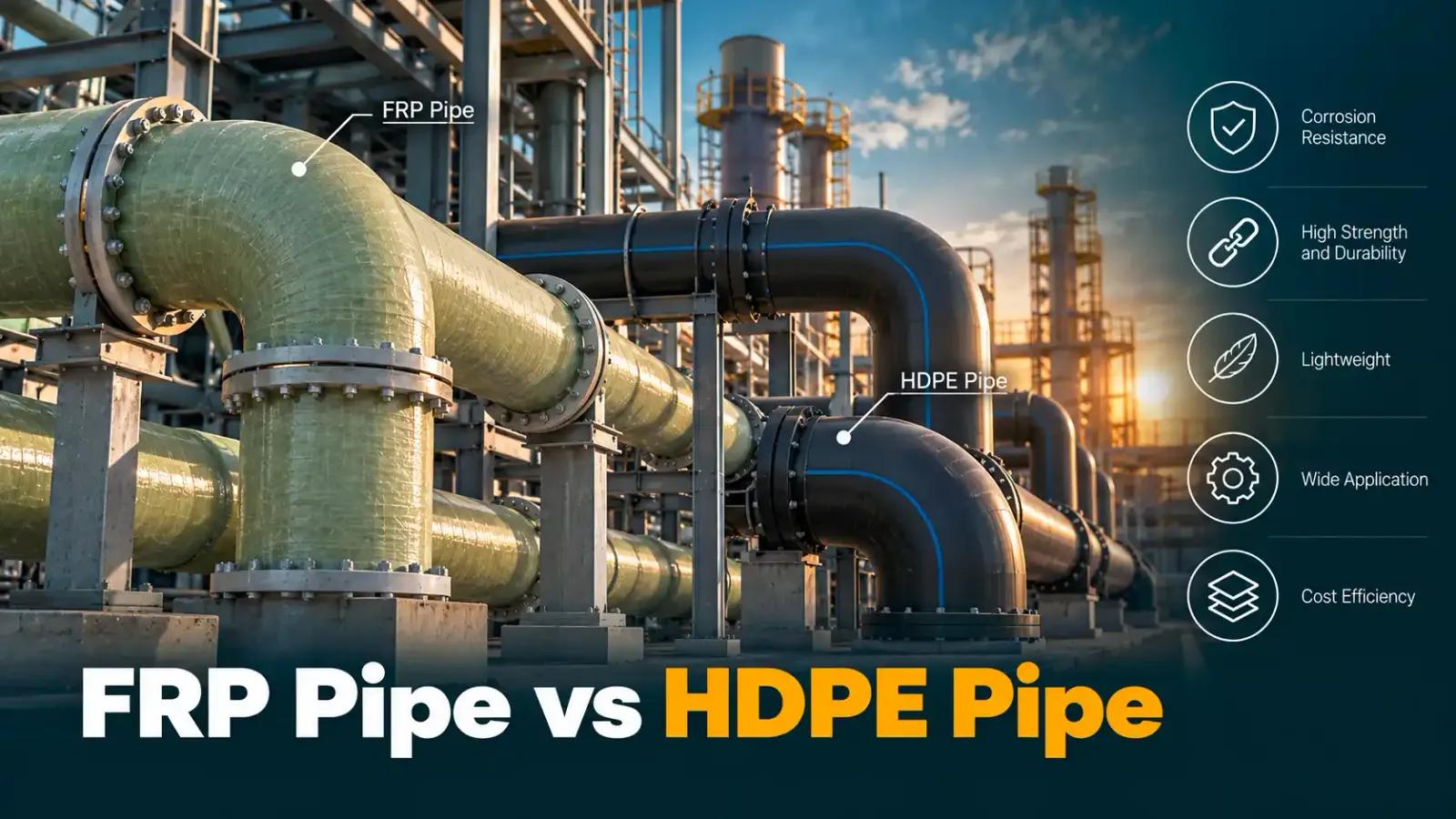
13 Oct 2026
Compare FRP pipe vs HDPE pipe in strength, chemical resistance, durability, installation, and cost to choose the right material for industrial use.
Read More →
30 Sept 2026
Learn how FRP grating is used in wastewater treatment plants, including walkways, platforms, corrosion resistance, load capacity, resin selection, and key specification factors.
Read More →