Choosing between a panel tank and a cylindrical FRP tank depends on the liquid being stored, available installation space, site access, operating conditions, and required accessories. Both tanks can provide reliable storage, but they are designed for different applications.
A panel tank is generally more suitable for modular water storage, especially inside buildings or restricted areas. A cylindrical FRP tank is usually selected for chemicals, industrial process liquids, mixing, and applications requiring a customized corrosion-resistant structure.
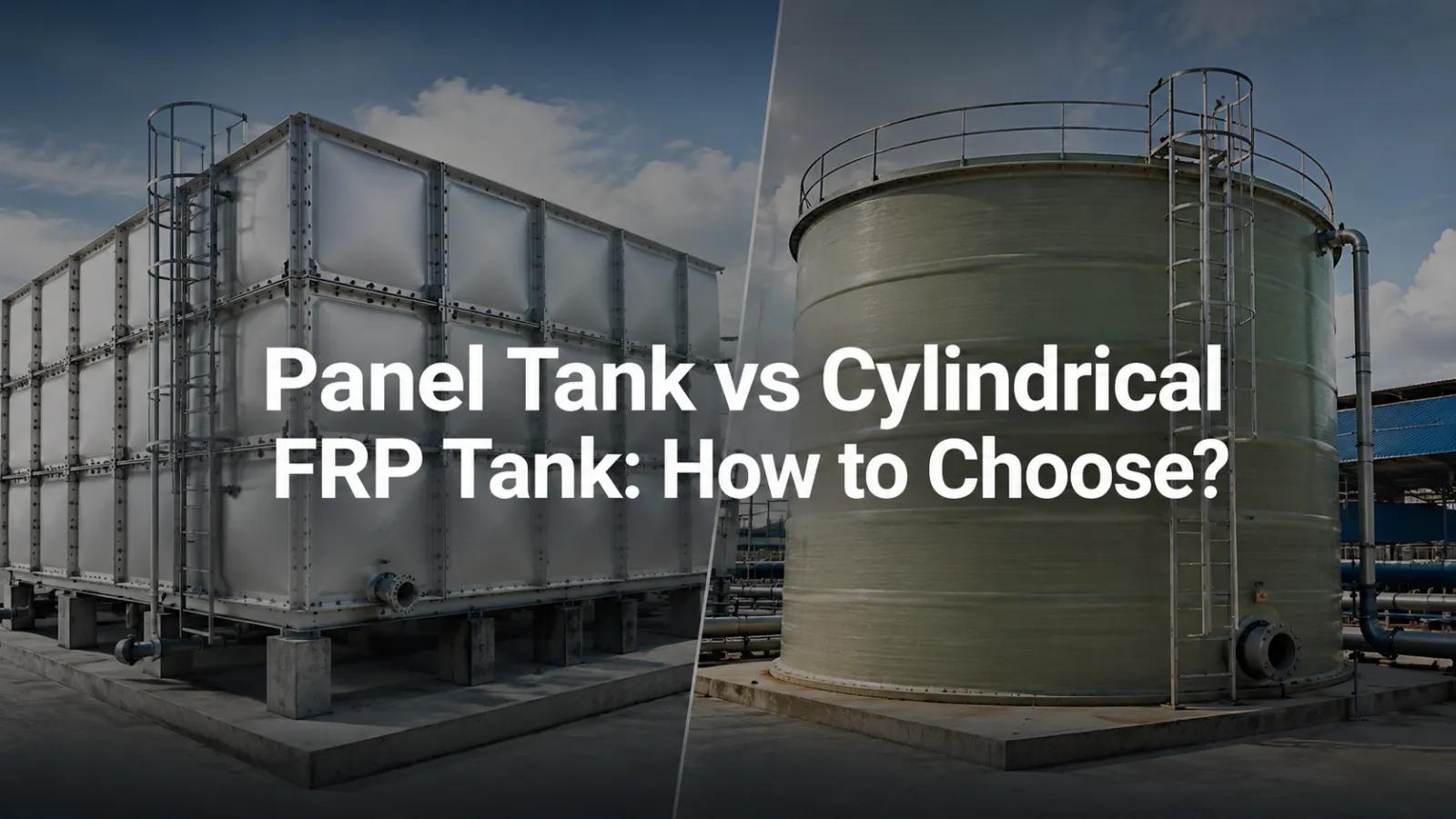
The following table provides a general comparison between the two tank systems.
| Comparison Factor | Panel Tank | Cylindrical FRP Tank |
|---|---|---|
Shape | Rectangular and sectional | Circular, vertical, or horizontal |
Main application | Water storage | Water, chemicals, and process liquids |
Installation | Assembled from panels on-site | Delivered as one unit or fabricated on-site |
Restricted access | Highly suitable | Depends on tank dimensions and access route |
Chemical resistance | Depends on panels, seals, and internal components | Resin and corrosion barrier can be selected for the chemical |
Internal joints | Multiple bolted and sealed joints | Continuous laminate with fewer mechanical joints |
Customization | Dimensions adjusted through panel arrangement | Resin, laminate, dimensions, nozzles, and accessories can be customized |
Mixing equipment | Generally intended for storage | Can be reinforced for mixers and agitators |
Space efficiency | Fits rectangular rooms efficiently | Requires a suitable circular footprint |
Main maintenance points | Bolts, seals, joints, and internal bracing | Laminate, nozzles, supports, and corrosion barrier |
This table should be used as an initial guide. The final tank selection should still be based on complete project data.
The stored liquid is usually the first factor to consider.
A panel tank is often suitable for potable water, building water supply, treated water, and fire-water storage. Its rectangular shape allows the tank to use the available room efficiently.
A cylindrical FRP tank can also store water, particularly for outdoor facilities, industrial treatment systems, or projects that require customized nozzles and vertical storage.
A cylindrical FRP tank is generally more appropriate for corrosive chemicals because the resin system and corrosion barrier can be selected according to:
A standard panel tank should not automatically be used for chemicals. The panels, seals, bolts, and internal supports must all be checked for compatibility.
Panel tanks provide a clear advantage when the installation area has limited access. Individual panels can be moved into basements, rooftops, mechanical rooms, or existing buildings before assembly.
Their rectangular design also helps use corners and wall-to-wall spaces more efficiently.
Cylindrical FRP tanks are suitable for open industrial areas where there is enough room for transportation, lifting, and foundation preparation. For very large tanks, site fabrication may be considered when one-piece delivery is not possible.
Both tank types can provide substantial storage capacity, but they achieve it differently.
A panel tank’s capacity is created by combining panels into the required length, width, and height. This makes it easier to follow the dimensions of an existing room.
A cylindrical FRP tank’s capacity is determined by its diameter, shell height, and operating level. A taller vertical tank may provide more storage without requiring a large floor area, although wind loads, foundations, and structural stability must be considered.
At GAJA Fiberglass, we manufacture BIO Panel® Tanks using hot-pressed SMC panels. We configure the panel arrangement, internal reinforcement, and dimensions according to the required water capacity and available installation space.
We also manufacture Fiber force® FRP Tanks using an advanced filament-winding system. Our team develops the resin system, laminate construction, diameter, height, nozzles, and accessories according to the stored liquid and approved operating conditions.
Panel tanks are primarily designed for water storage. Adding heavy mixers or process equipment may create loads that the standard panels and bracing system were not designed to support.
Cylindrical FRP tanks can be engineered for:
Before designing the tank, the manufacturer should receive information about the equipment weight, torque, vibration, and mounting arrangement.
Both tanks require regular inspection, but the inspection points are different.
A panel tank should be inspected for leaking joints, damaged seals, loose bolts, movement in internal bracing, corrosion on metallic parts, and sediment accumulation.
Regular cleaning is especially important for potable-water and building water-storage applications.
A cylindrical FRP tank should be checked for surface cracks, impact damage, leakage around nozzles, foundation movement, deformation, and changes in the corrosion-resistant inner surface.
Inspections should also be performed after overfilling, abnormal pressure, chemical changes, or accidental impact.
Choose a panel tank when:
Choose a cylindrical FRP tank when:
A panel tank is not automatically better than a cylindrical FRP tank. The right choice depends on the stored liquid, available space, site access, process requirements, and maintenance conditions.
At GAJA Fiberglass, we review your water or chemical service, required capacity, installation dimensions, access limitations, connections, and operating conditions before recommending a BIO Panel® Tank or Fiber force® FRP Tank.
Indonesia Head Office
Email: marketing@gajafiberglass.com
Phone: +62 (21) 4585-3491
WhatsApp: +62 811-186-7919
Australia Representative
Contact Person: Mr. Victor Bhave
Email: victor.bhave@gajafiberglass.com
Phone: +61 41 424-0017
SMC panels contain resin and glass-fibre reinforcement, but their manufacturing process differs from a filament-wound cylindrical FRP tank.
They may store certain compatible liquids, but all panels, seals, bolts, and internal components must be evaluated. Panel tanks are mainly used for water.
A cylindrical FRP tank is generally more suitable because its resin and corrosion barrier can be selected according to the acid, concentration, and temperature.
A panel tank is usually easier to install because separate components can be transported into the room before assembly.
Yes. However, the tank must be designed for sunlight, rainfall, wind loads, foundation conditions, and other environmental exposure.

3 Oct 2026
Learn about FRP pipe stiffness class, key factors in pipe selection, and how to choose the right stiffness for underground and aboveground applications.
Read More →
30 Sept 2026
Explore FRP tank solutions for copper smelter applications, including corrosion resistance, resin selection, design factors, material considerations, and GAJA's industrial project experience.
Read More →
30 Sept 2026
Discover FRP tank applications in oil and gas facilities, including chemical storage, wastewater, process water, corrosion resistance, selection factors, and real industrial project experience.
Read More →