FRP pipe supports are an important part of an FRP piping system because they help carry the weight of the pipe, fluid, fittings, and other components while controlling movement and deflection. Unlike steel piping, FRP has different mechanical properties that affect how the pipe should be supported and how far apart each support should be installed.
Choosing the correct FRP pipe support therefore involves more than simply placing brackets at regular intervals. Pipe diameter, wall construction, fluid weight, operating temperature, support configuration, thermal movement, and allowable deflection should be considered during the design stage. Support recommendations should also follow the technical data provided for the specific FRP pipe system.
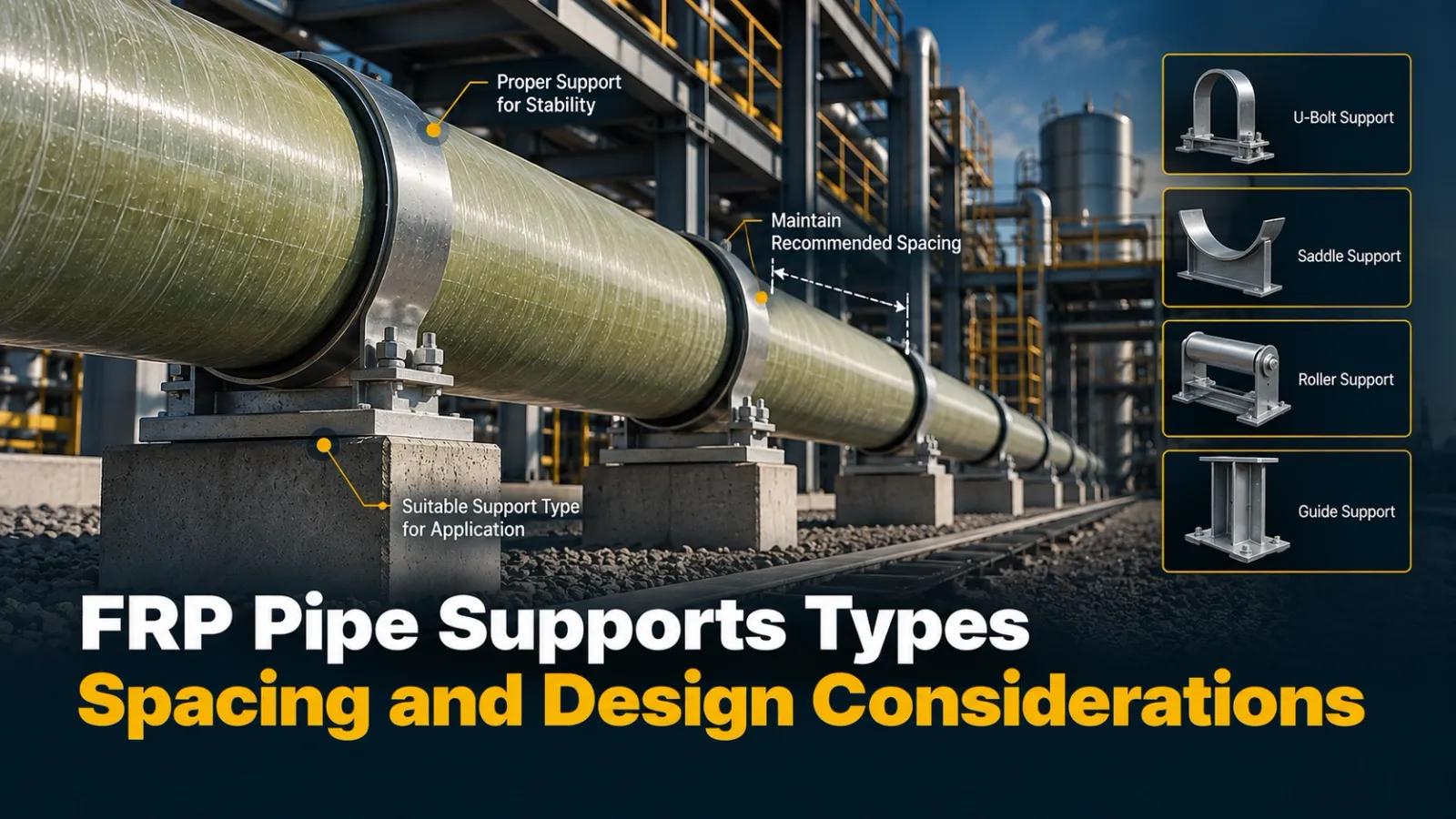
FRP pipe supports are structural components used to support and stabilize fiberglass reinforced plastic piping. They can be installed on pipe racks, structural steel, equipment supports, or other suitable structures depending on the piping layout.
The primary functions of an FRP pipe support include:
For industrial applications, FRP pipe supports should be designed as part of the complete piping system rather than treated as an independent component. GAJA manufactures FRP Pipe & Fittings for applications involving the transportation of chemicals and other liquids, making support selection an important consideration when developing a complete FRP piping system.
FRP piping has a relatively lower modulus of elasticity than steel, meaning it can behave differently under bending and external loads. As a result, simply applying steel pipe support spacing to an FRP piping system may lead to excessive deflection or other design issues.
Properly designed supports help distribute the pipe load over an adequate contact area. They also help prevent excessive sagging, vibration, and localized stress that could affect the piping system during operation. Support design becomes particularly important when the pipeline contains heavy fluids, operates at elevated temperatures, includes valves or fittings, or has long horizontal runs.
The type of FRP pipe support depends on the function required and the piping configuration. Common support arrangements include weight supports, guides, and anchors.
Weight supports carry the vertical load of the piping system. They are commonly positioned beneath horizontal pipe sections to transfer the pipe and fluid weight to the supporting structure. The support should provide sufficient contact area rather than concentrating the load at a small point.
Guides help control lateral movement while allowing the pipe to move in the intended direction. They can be important in systems where thermal expansion and contraction need to be accommodated. The guide arrangement should prevent unwanted sideways movement without creating excessive localized stress.
Anchors restrict movement at designated locations and divide a piping run into controlled expansion sections. Anchor locations need to be established as part of the overall piping design because excessive restraint can transfer significant loads into the pipe or connected equipment.
Clamps and saddles can be used to hold and support FRP piping. Because FRP can be sensitive to concentrated loads and abrasion, the contact surface should be properly designed. Elastomeric liners are commonly recommended between the support and FRP pipe to reduce abrasion and provide a more uniform contact surface.
FRP pipe support spacing should not be selected using one universal distance for every project. The required spacing depends on pipe diameter, wall thickness, mechanical properties, fluid density, temperature, support configuration, and allowable deflection.
For example, ISO 14692 guidance provides indicative span values for GRP pipes filled with water, ranging from approximately 2.0 m for a 25 mm nominal diameter pipe to around 6.0 m for a 600 mm pipe under the stated design conditions. These values are guidance rather than a universal spacing table for every FRP piping application. Actual FRP pipe support spacing should therefore be confirmed using the pipe manufacturer's technical data and project-specific engineering calculations.
Several factors should be evaluated when developing an FRP pipe support design.
Pipe diameter, wall thickness, laminate construction, and mechanical properties influence the allowable span. Larger pipes do not automatically mean that supports can be spaced farther apart without checking the design conditions.
The support system needs to carry both the empty pipe weight and the operating weight of the contained fluid. Heavy fluids can significantly increase the load on horizontal piping. Other components such as insulation may also add weight and should be included where applicable.
Excessive deflection can cause sagging and affect the alignment of the piping system. Support spacing should therefore be checked against the allowable deflection for the specific pipe. ISO 14692 guidance, for example, considers a deflection criterion of 0.5% of span or 12.5 mm at the center, whichever is smaller, under its stated assumptions.
FRP piping can expand and contract as operating temperature changes. The support arrangement should allow the intended movement while preventing excessive lateral movement or unwanted loads on connected equipment. Anchors and guides should therefore be positioned based on the thermal movement analysis rather than simply installed at convenient structural locations.
Valves, pumps, flowmeters, and other concentrated loads may require independent support. Their weight should not automatically be transferred to the FRP pipe unless the system has been specifically designed for those loads.
During installation, the support surface should be smooth and properly aligned with the pipe. Narrow contact points should be avoided because they can create localized stress on the FRP wall.
Supports should generally be positioned on suitable straight pipe sections rather than directly at fittings or joints unless the engineering design specifically requires another arrangement. Protective liners can also help reduce abrasion between the pipe and support.
Installers should follow the approved piping drawings and the manufacturer's recommended support locations. Any changes to support spacing during installation should be reviewed because moving a support can change the loading and deflection behavior of the piping system.
FRP pipes can be supported using suitable metallic structural supports, but the interface between the two materials requires attention. Direct contact between rigid metal and FRP can create abrasion or localized loading.
For this reason, the support design may incorporate wider saddles, protective liners, or other suitable contact materials. The support should also accommodate the outside diameter and movement characteristics of the specific FRP pipe. The objective is not simply to make the support strong, but to distribute loads appropriately while maintaining the required movement and alignment of the FRP piping system.
Before finalizing an FRP pipe support design, project teams should review:
The final support arrangement should be based on the specific FRP pipe manufacturer's recommendations and applicable engineering requirements rather than relying on a generic spacing value.
GAJA has experience manufacturing industrial FRP products, including FRP Pipe and FRP Pipe Fittings. Its FRP Pipe manufacturing facility was established in 2017, while GAJA entered the Malaysian market with FRP Pipe Fittings in 2021. GAJA also supplied GRP Pipe for the MRT Jakarta Phase 2 project in 2022. For projects requiring an FRP piping system, support requirements should be considered together with pipe dimensions, operating conditions, fittings, and installation requirements.
If you need assistance discussing FRP pipe, fittings, support requirements, or project-specific piping applications, you can contact GAJA to discuss your project requirements with the team.
FRP pipe supports are components used to carry and stabilize FRP piping while controlling deflection, movement, and vibration.
FRP pipe support spacing depends on pipe diameter, wall construction, fluid weight, temperature, mechanical properties, allowable deflection, and the support configuration. Manufacturer recommendations should be followed.
Yes. Suitable structural steel supports can be used, provided the contact area, protective lining, pipe movement, and localized stress are properly considered.
Depending on the piping design, guides and anchors may be required to control thermal and lateral movement. Their location should be determined through the piping design rather than installed arbitrarily.
A suitable liner can reduce abrasion and help distribute contact pressure between the support and FRP pipe. This is particularly important where rigid support materials could create localized stress or surface wear.
3 Oct 2026
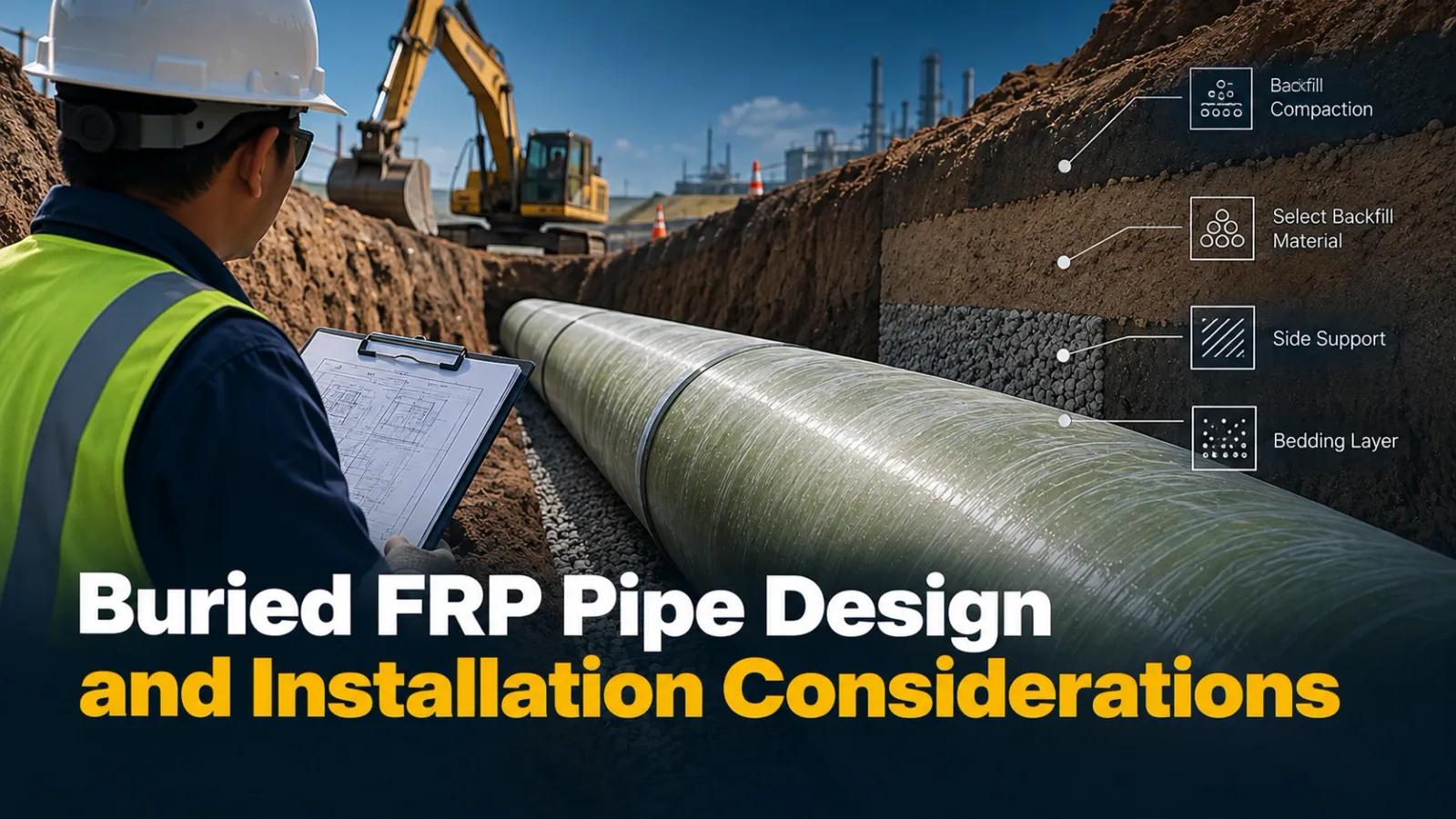
Learn key buried FRP pipe design and installation considerations, including soil loads, burial depth, bedding, backfilling, and external pressure.
Read More →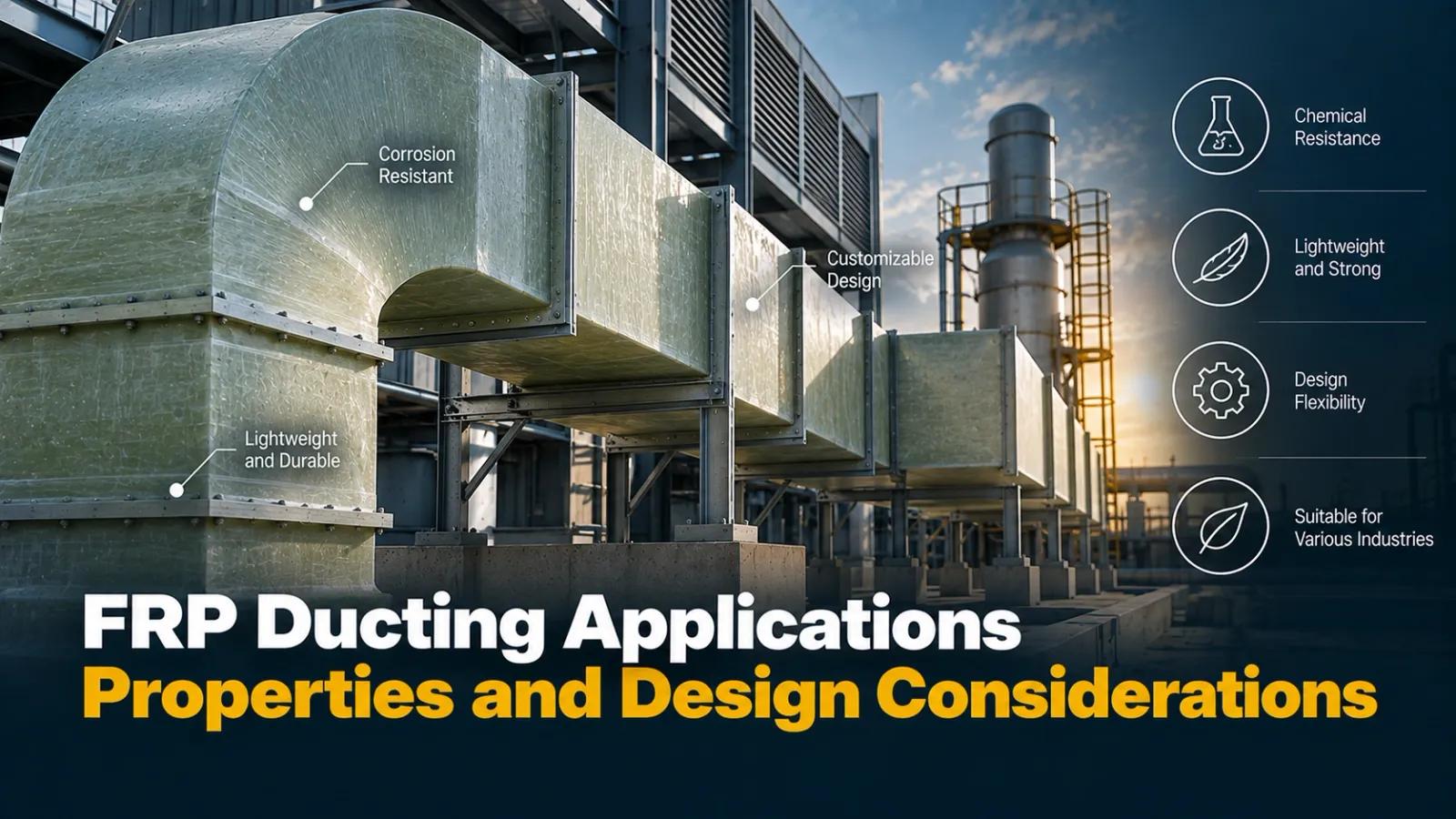
3 Oct 2026
Learn about FRP ducting applications, properties, material selection, and key design considerations for corrosive industrial environments.
Read More →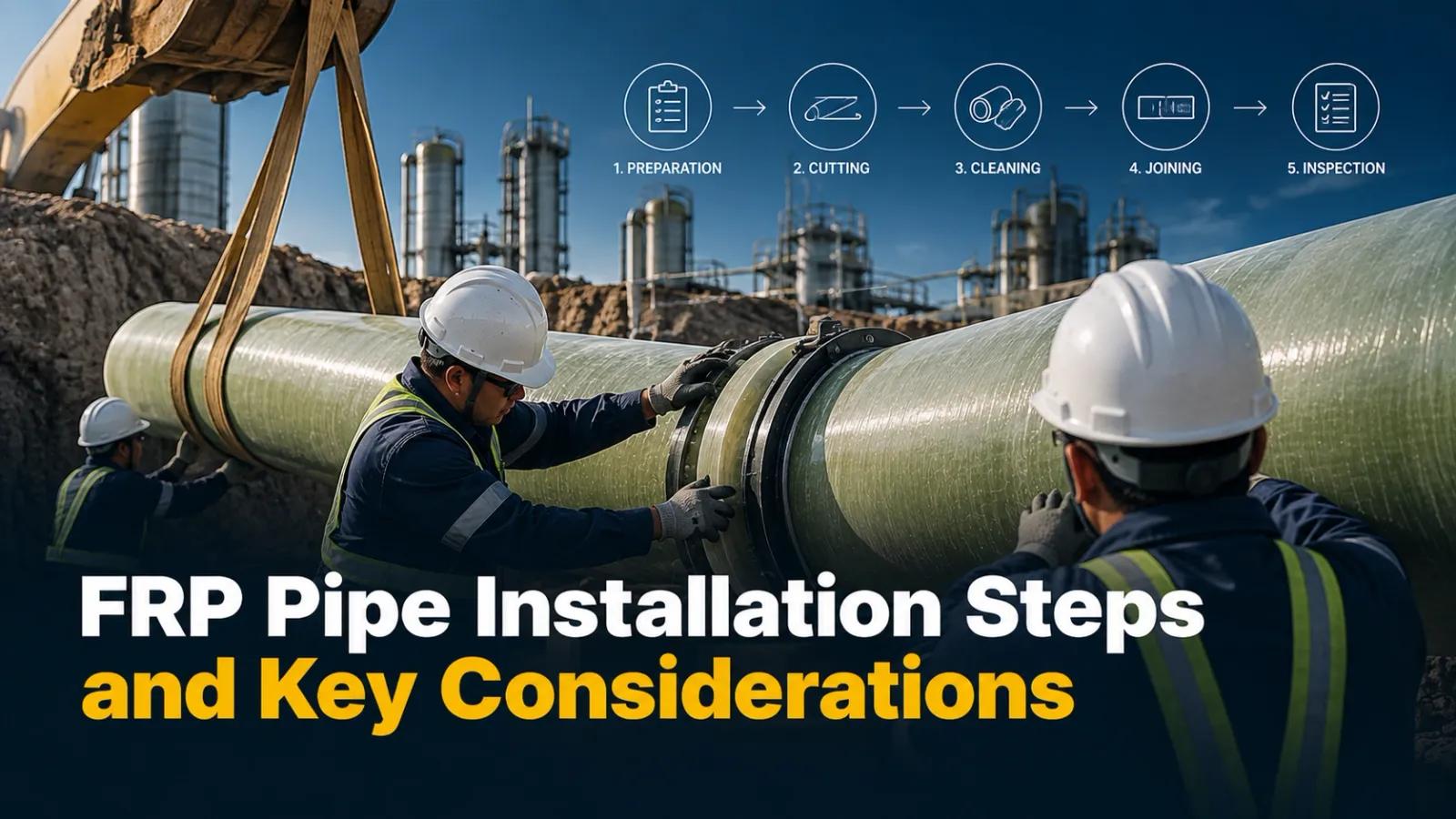
3 Oct 2026
Learn FRP pipe installation steps, joining methods, support requirements, alignment, and key considerations for safe and reliable piping systems.
Read More →