FRP pipe joining methods determine how individual pipe sections, fittings, valves, and other components are connected into a complete piping system. Selecting the appropriate joint is important because the connection must accommodate the pipe diameter, pressure, operating temperature, chemical environment, and installation conditions.
Fiber Reinforced Plastic (FRP) pipes combine fiberglass reinforcement with a polymer resin system. They are used in applications such as chemical processing, water treatment, industrial utilities, and corrosive service environments. GAJA manufactures FRP Pipe & Fittings for transporting chemicals and other liquids across various industrial applications.
The joining method should therefore be considered during the piping design stage rather than treated only as an installation detail.

FRP pipe joining methods are techniques used to connect two or more FRP pipe components while maintaining the required mechanical integrity and, where applicable, pressure tightness of the piping system.
Common FRP pipe joint types include:
The available methods can vary according to the FRP pipe design and manufacturer. For example, Future Pipe lists flanged, lamination, adhesive bonded, and rubber seal jointing systems across different GRP/FRP product series.
Understanding the characteristics of each FRP pipe connection helps project teams determine which method is appropriate for a particular application.
A flanged joint connects pipe sections or FRP components using mating flanges, bolts, nuts, washers, and a gasket where required. This method is commonly used when the piping needs to connect with valves, pumps, equipment, or piping made from different materials.
One advantage of a flanged FRP pipe connection is that it can be disassembled when equipment or piping components require maintenance.
Proper alignment is particularly important. Installation guidance for GRP piping recommends that flanges be aligned correctly and tightened using the specified sequence and torque. The pipe should not be pulled into alignment using flange bolts because this can introduce excessive stress into the connection.
A lamination joint connects plain-ended FRP pipes by applying resin-impregnated fiberglass reinforcement around the prepared pipe ends. The reinforcement is built up over a specified length and thickness according to the pipe diameter and pressure requirements.
The general FRP lamination joint process includes:
Because the joint is fabricated directly around the pipe, proper surface preparation, alignment, resin handling, and curing are important for achieving the required joint performance. Manufacturer procedures should be followed for the specific pipe system.
An adhesive bonded or cemented joint uses a compatible adhesive system to connect pipe components. This type of FRP pipe joining can provide a restrained connection and may be suitable for certain pressure and installation conditions.
However, adhesive compatibility should not be assumed based only on the pipe material. The adhesive system, pipe resin, diameter, pressure, temperature, and service fluid should be reviewed before installation.
For example, Future Pipe identifies adhesive bonded joints for specific WAVISTRONG systems and provides application limits according to the particular product series.
Mechanical coupling provides another FRP pipe connection option, particularly when connecting FRP to another pipe material or when a specific installation configuration requires a mechanical connection.
Some FRP pipe systems can use mechanical couplings supplied by specialized manufacturers. These couplings can be useful when connecting different pipe materials, but their compatibility, pressure rating, dimensions, and installation requirements should be verified for the project.
Some GRP pipe systems use bell-and-spigot joints with elastomeric seals. The seal provides the connection and helps maintain tightness between the pipe sections.
This type of joint is commonly associated with certain buried piping systems. For example, Future Pipe describes double-bell coupling systems as non-restrained joints that can accommodate flexibility and deflection but may require thrust blocks or hybrid restraint systems depending on the application.
The correct FRP pipe joining method depends on more than pipe diameter. Project teams should evaluate:
For example, a flanged connection may be practical around pumps and valves where disassembly is required, while a lamination joint may be selected for permanent connections between compatible plain-ended FRP pipes.
The joint should also be considered together with the overall piping support system. Incorrect alignment, excessive external loads, or inadequate support can affect joint performance even when the selected joining method itself is appropriate.
Proper installation is essential for maintaining the performance of FRP pipe joints. Before joining, the pipe ends should be inspected for damage, dimensions should be verified, and surfaces should be prepared according to the manufacturer's instructions.
For flanged connections, alignment and controlled bolt tightening are particularly important. For lamination joints, surface preparation, cleanliness, resin mixing, reinforcement placement, and curing conditions require careful control. Installation procedures should always follow the approved manufacturer's documentation for the specific FRP pipe system.
Selecting an experienced FRP manufacturer can help project teams evaluate the pipe, fittings, and connection requirements as part of the overall piping system. GAJA has manufactured FRP Pipe and Fittings for industrial applications and has supported projects including MRT Jakarta Phase 2. Its project portfolio also includes FRP Pipe, Fitting, and Duct manufacturing for the Bondi STP Ventilation project commissioned by Sydney Water.
GAJA has operated an FRP Pipe manufacturing facility since 2017 and has also supplied FRP Pipe for acid line piping applications.
For projects requiring customized FRP pipe dimensions, fittings, or joining requirements, contact GAJA to discuss the operating conditions, dimensions, pressure, chemical service, and installation requirements. GAJA's Indonesia head office can be contacted through its official contact channels.
Common methods include flanged joints, lamination or butt-and-wrap joints, adhesive bonded joints, mechanical couplings, and rubber seal bell-and-spigot joints for applicable systems.
Flanged joints are commonly used for connecting FRP piping to valves, pumps, equipment, and other piping materials because the connection can be assembled and disassembled.
An FRP lamination joint connects plain-ended pipes by applying resin and fiberglass reinforcement around the prepared pipe ends. The laminate thickness and length depend on factors such as pipe diameter and pressure.
Yes. Depending on the system design, FRP pipe can be connected to other piping materials using methods such as flanged connections or suitable mechanical couplings. Compatibility and installation requirements should be verified before installation.
Consider pressure, temperature, pipe diameter, chemical exposure, installation location, connection to equipment, required restraint, maintenance requirements, and the manufacturer's recommended joining procedure.
3 Oct 2026
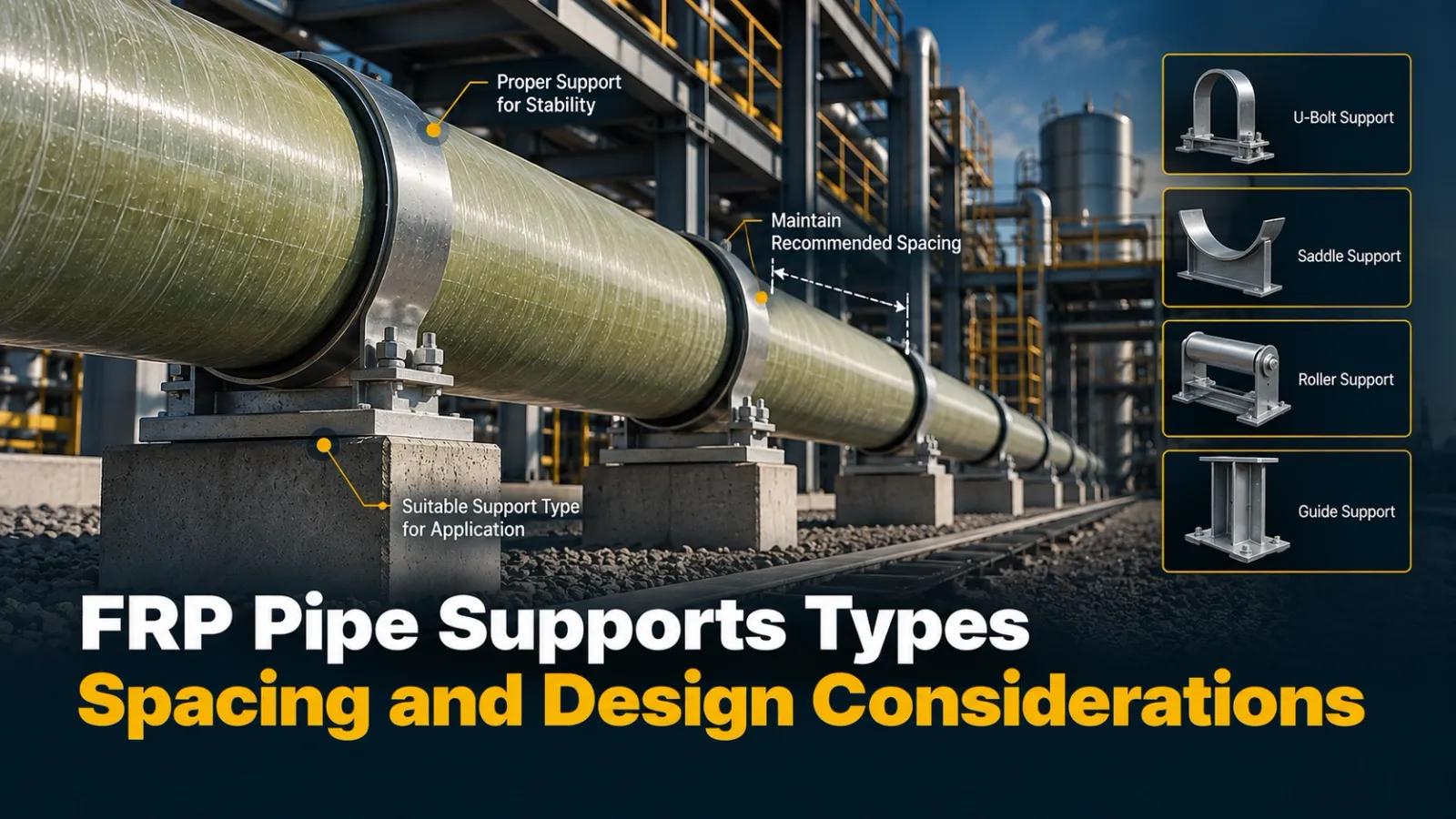
Learn about FRP pipe supports, types, spacing, load considerations, and design factors for safe and reliable FRP piping systems.
Read More →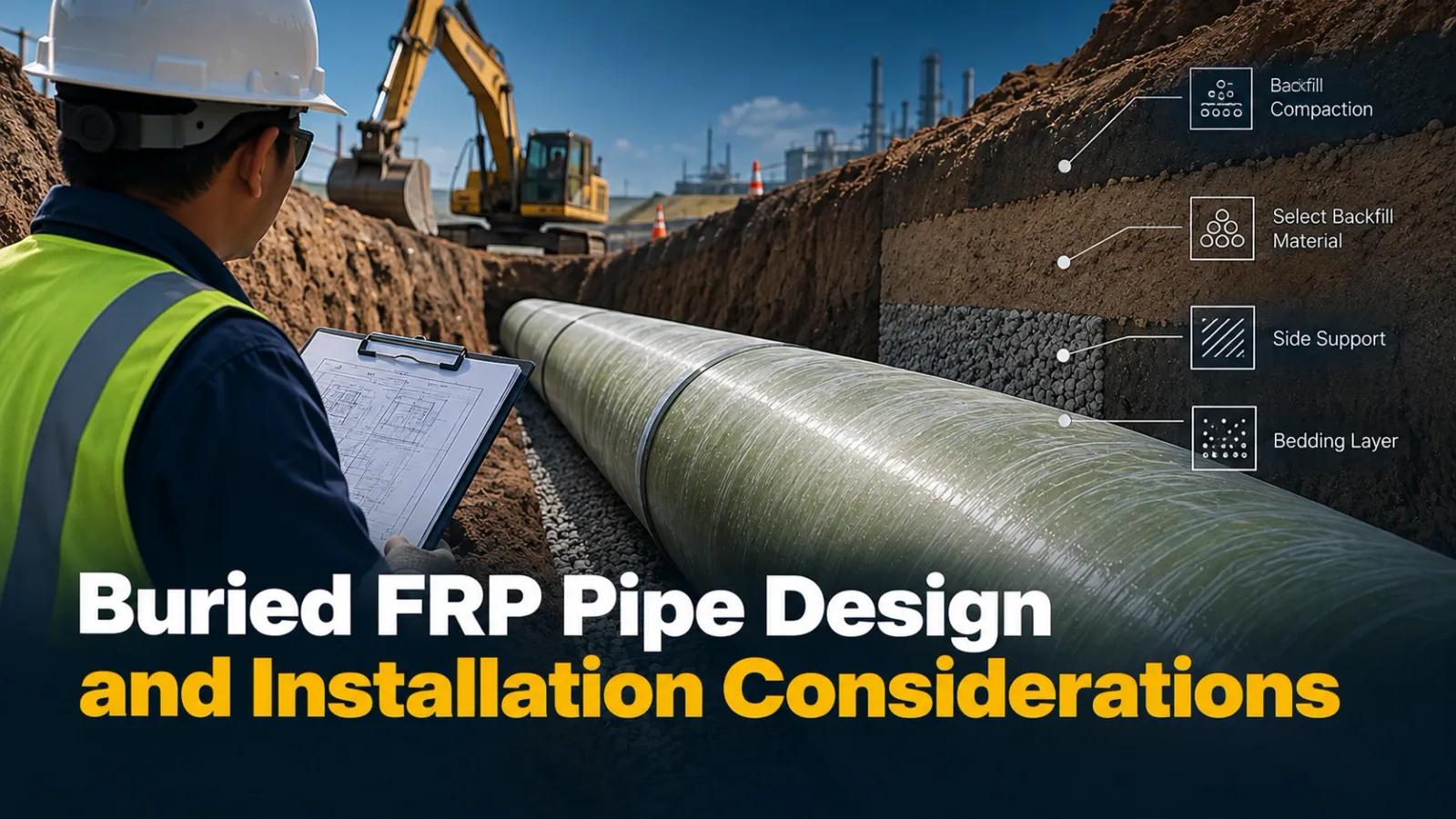
3 Oct 2026
Learn key buried FRP pipe design and installation considerations, including soil loads, burial depth, bedding, backfilling, and external pressure.
Read More →
3 Oct 2026
Learn FRP pipe installation steps, joining methods, support requirements, alignment, and key considerations for safe and reliable piping systems.
Read More →