FRP lining thickness is an important consideration when using fiberglass reinforced plastic as a corrosion protection system for tanks, pipes, ducts, vessels, and other industrial equipment. The required thickness is not determined by a single universal value because each application can have different chemical, thermal, mechanical, and operating conditions.
A properly designed FRP lining system generally combines a corrosion-resistant resin system with fiberglass reinforcement. According to Ashland's technical guidance for corrosion-resistant FRP, corrosion barriers are commonly designed as multilayer systems, with the thickness and construction depending on the specific chemical environment and application.
Therefore, selecting the appropriate FRP liner thickness requires evaluating the complete service environment rather than simply choosing the thickest available lining.
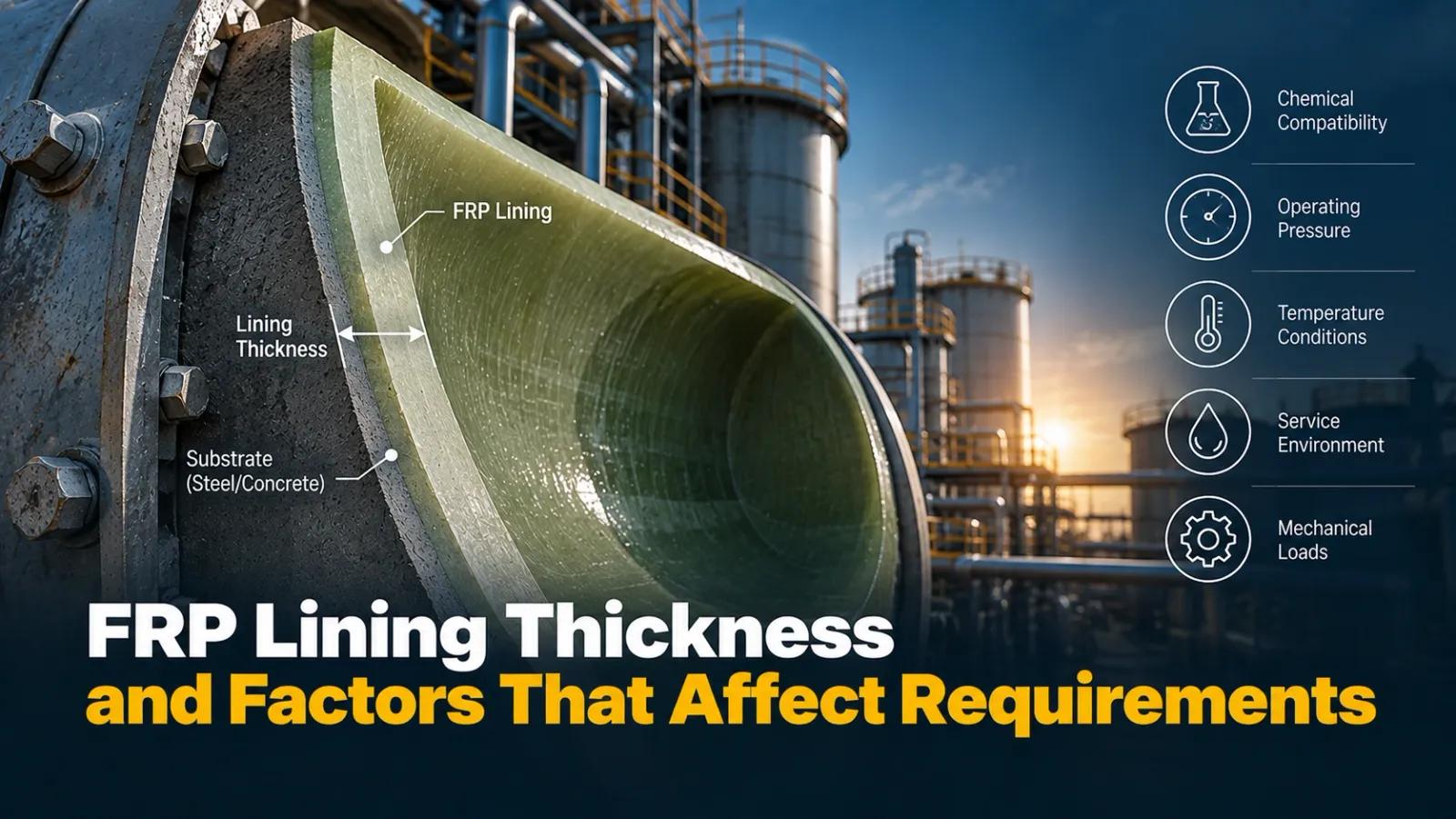
FRP lining thickness refers to the total thickness of the protective fiberglass-reinforced lining applied to a substrate or incorporated into an FRP component. Depending on the design, the system can consist of resin-rich surface layers, fiberglass reinforcement, and additional structural or protective layers.
The primary purpose of an FRP lining is to protect the underlying substrate from corrosion, chemical attack, moisture, or other service conditions. The lining can be applied to equipment such as:
The final thickness should be determined according to the required FRP lining system, resin properties, reinforcement, and operating conditions.
The correct thickness helps ensure that the lining provides the intended level of protection throughout its expected service life. An FRP lining that is not properly specified may have insufficient protection against the actual service environment.
However, thicker does not automatically mean better. The performance of an FRP lining also depends on resin selection, reinforcement configuration, adhesion, substrate preparation, curing, workmanship, and compatibility with the chemicals involved. Ashland notes that corrosion-resistant FRP systems are designed around specific chemical environments and that the performance of the laminate depends on proper design, fabrication, and installation.
Several factors should be evaluated before determining the required FRP lining thickness.
Chemical concentration and type are among the most important considerations. Acids, alkalis, solvents, oxidizing chemicals, wastewater, and other process fluids can have different effects on a lining system. The selected resin should therefore be compatible with the chemical being handled. A chemical resistance guide or manufacturer data should be reviewed rather than assuming that one resin system is suitable for every application.
Temperature can affect the chemical resistance and mechanical performance of resin systems. A chemical that is relatively manageable at ambient temperature may require a different lining specification at elevated temperatures. For this reason, both normal and maximum operating temperatures should be included when determining FRP lining requirements.
Chemical exposure is not the only concern. Slurries, solids, particles, cleaning activities, or material movement can create abrasion. Where abrasion is expected, the lining may require a suitable reinforced or abrasion-resistant construction. For example, NOV's fiberglass piping products specify different liner constructions for abrasive and corrosive services, demonstrating that liner configuration can vary according to the operating environment.
For an FRP lining application on an existing surface, the condition of the substrate is also important. Rust, oil, moisture, contamination, damaged concrete, or other surface defects can affect adhesion and overall lining performance.
Proper substrate preparation for FRP lining should therefore be considered part of the specification rather than treating thickness as the only design variable.
The required service life can influence the selection of resin, reinforcement, corrosion barrier, and overall lining construction. Applications with demanding continuous chemical exposure may require a more robust system than applications with intermittent or mild exposure.
The design should therefore consider how frequently the equipment will be exposed to the process environment and the expected operating period.
A practical approach is to evaluate the application in several stages:
This approach is more reliable than selecting an FRP liner thickness based solely on the equipment type. For example, an FRP lining for a chemical storage tank may have different requirements from an FRP lining for a wastewater duct or pipe. Even two tanks containing different chemicals may require different resin systems and lining configurations.
Not necessarily. FRP lining performance depends on the complete system, including resin chemistry, fiberglass reinforcement, layer configuration, adhesion, curing, and surface preparation.
Ashland's technical guidance illustrates this principle by describing corrosion barriers as multilayer constructions rather than simply specifying a single thickness. Its guidance describes corrosion barriers in the range of approximately 2.5–6.3 mm for typical corrosion-resistant FRP structures, while noting that the construction is designed for a specific chemical environment.
These values should not be treated as a universal requirement for every FRP lining project. The appropriate specification must be determined from the actual service conditions and applicable design requirements.
When selecting an FRP lining, project teams should provide as much application information as possible, including:
GAJA provides FRP solutions for industrial applications, including FRP Lining, which can be evaluated according to project requirements and operating conditions.
For projects requiring corrosion protection for tanks, pipes, ducts, or other industrial equipment, contact GAJA to discuss the chemical environment, operating temperature, substrate condition, and required FRP lining thickness before finalizing the specification.
FRP lining thickness is the total thickness of a fiberglass-reinforced protective lining system. It can consist of resin-rich layers, fiberglass reinforcement, and other layers depending on the application.
There is no single thickness suitable for every application. The required thickness depends on chemical exposure, temperature, abrasion, substrate, resin system, and expected service life.
Important factors include chemical concentration, operating temperature, mechanical exposure, substrate condition, resin selection, reinforcement, and expected service life.
No. Lining performance depends on the complete system and proper installation, not thickness alone. Resin compatibility, reinforcement, adhesion, and substrate preparation are also important.
FRP lining can be considered for tanks, pipes, ducts, vessels, wastewater equipment, chemical process equipment, and other applications where corrosion protection is required.
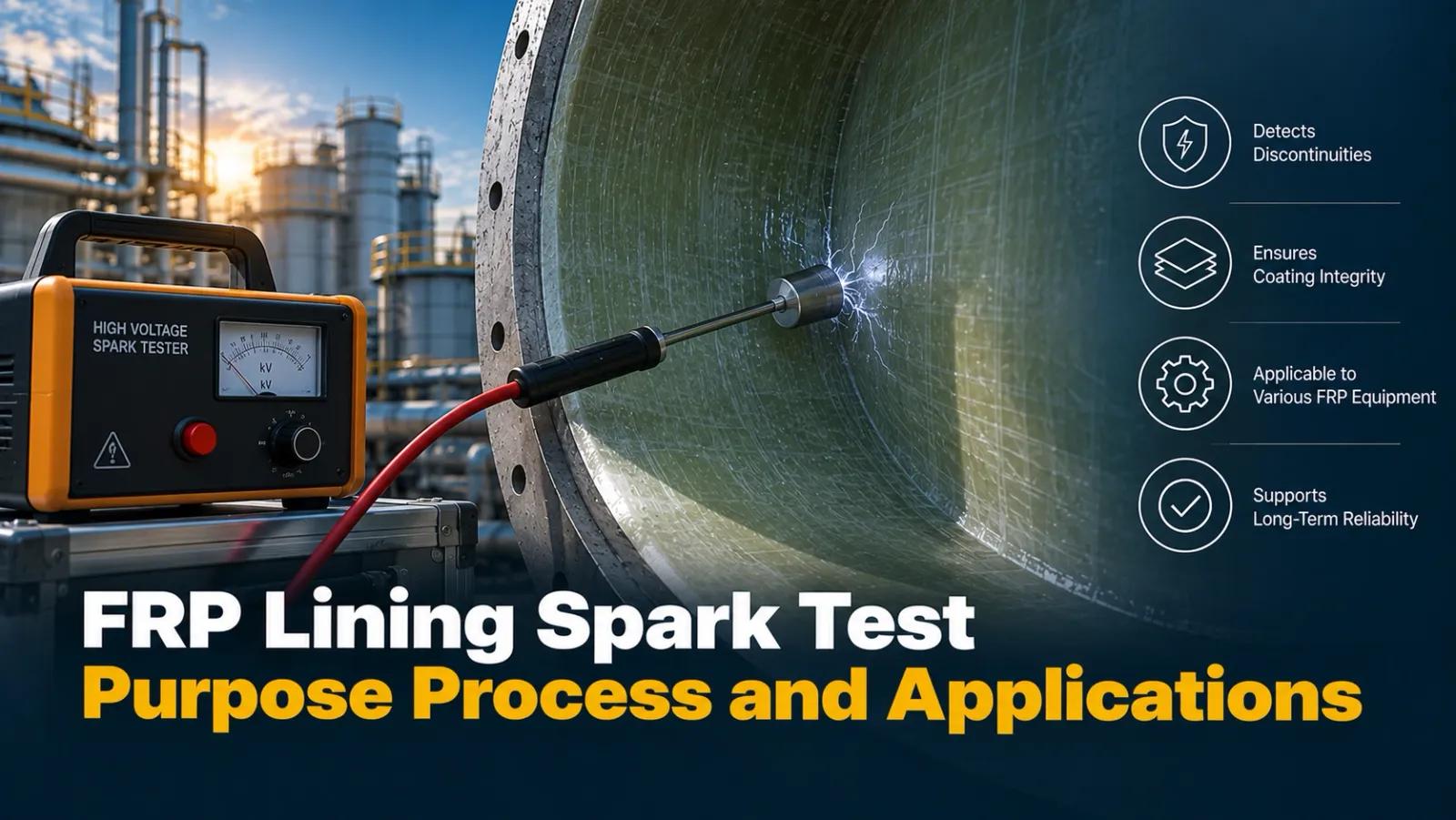
3 Oct 2026
Learn how FRP lining spark tests detect pinholes and defects, including the testing process, applications, safety factors, and inspection considerations.
Read More →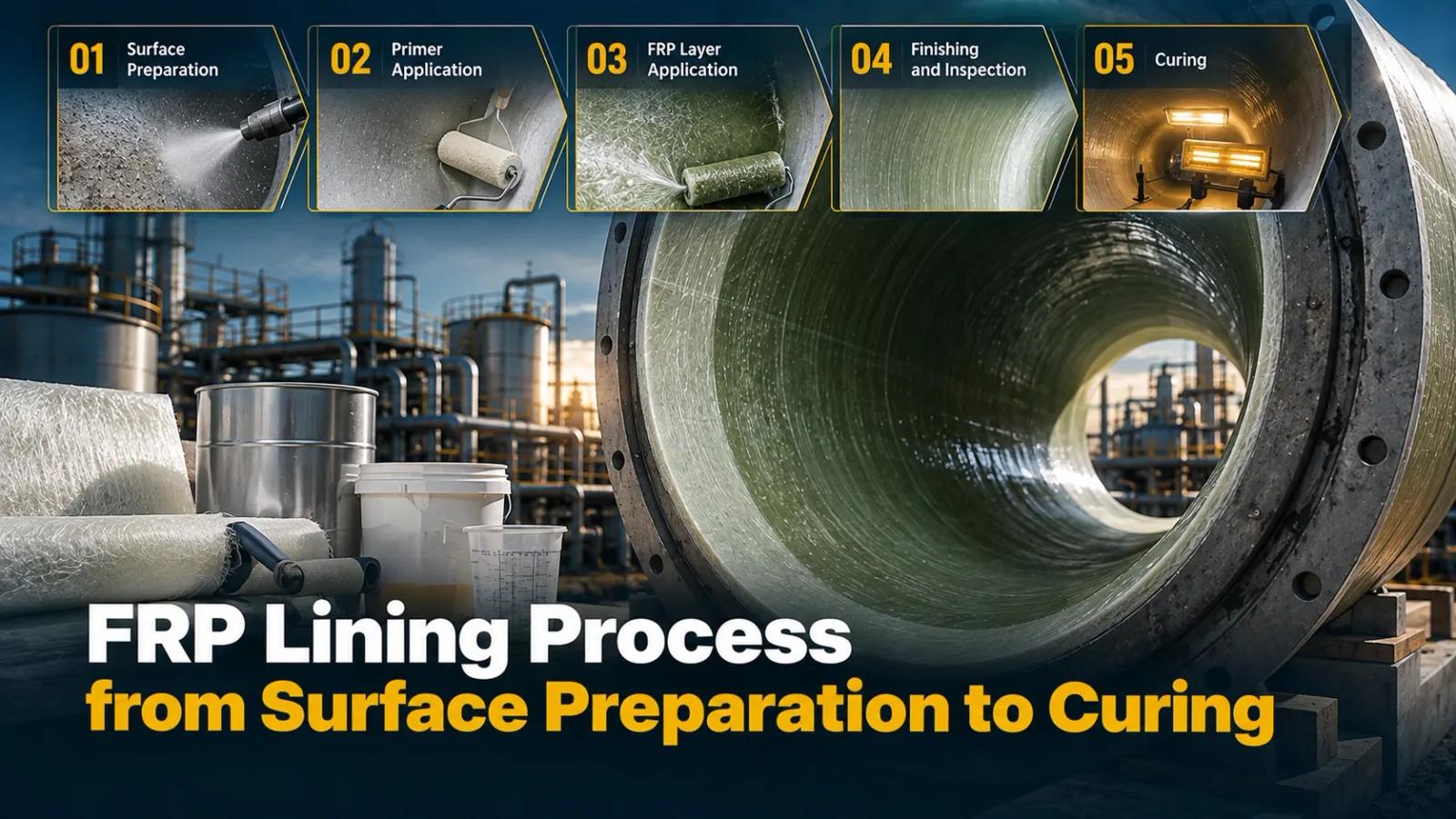
3 Oct 2026
Learn the FRP lining process from surface preparation and resin application to curing, inspection, and key installation considerations.
Read More →
30 Sept 2026
FRP tanks for chemical processing plants offer corrosion resistance, durability, and customizable design for handling acids, alkalis, and industrial chemicals
Read More →