Chemical resistant roofing materials are essential for factories, chemical plants, and industrial facilities exposed to corrosive fumes, moisture, and harsh environmental conditions. Unlike conventional roofing, these materials are designed to reduce deterioration caused by chemical exposure and help protect buildings from premature damage. Choosing the right roofing material can reduce maintenance requirements, improve building durability, and support safer industrial operations.
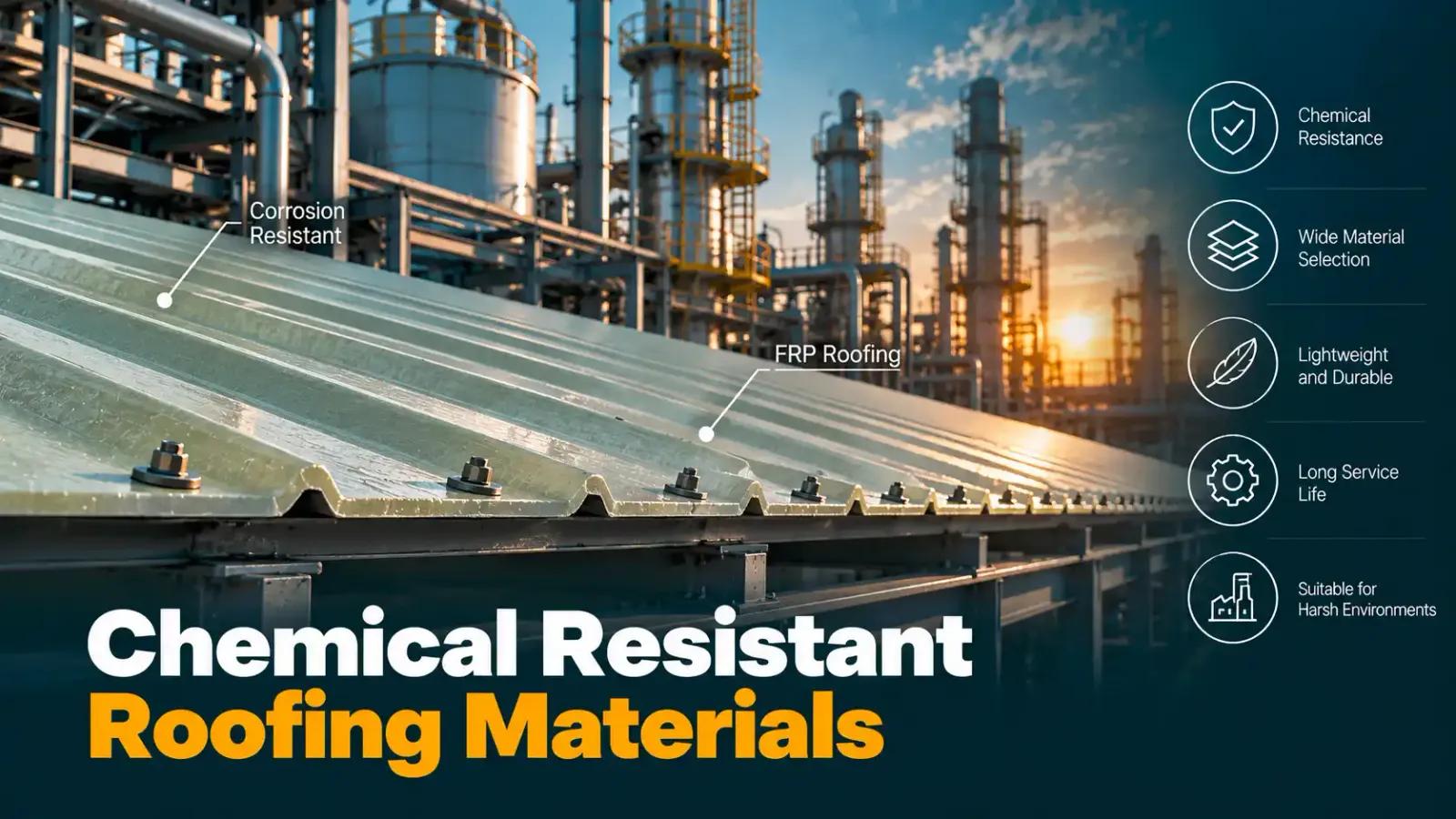
Chemical resistant roofing materials are specially designed to withstand exposure to certain chemicals, acidic vapors, alkaline substances, and other corrosive elements found in industrial environments.
These materials are commonly used in fertilizer plants, chemical manufacturing facilities, wastewater treatment plants, and coastal industrial buildings. Their performance depends on material composition, protective coatings, chemical concentration, and operating temperature. Different roofing systems provide different levels of protection, making material selection an important part of industrial building design.
Several roofing materials are suitable for industrial environments where corrosion protection is a priority. Each offers different advantages depending on chemical exposure and structural requirements.
FRP roofing is manufactured using fiberglass reinforcement combined with polymer resin. This composite structure provides mechanical strength, lightweight construction, and corrosion resistance.
Unlike conventional steel roofing, FRP does not rust when exposed to moisture. Specialized resin formulations can also resist various industrial chemicals. FRP roofing sheets are commonly used in chemical processing plants, fertilizer factories, warehouses, and industrial facilities exposed to corrosive fumes.
GAJA manufactures Composite Alum® GFRP Roof, featuring chemical resistant resin and a UV protective PE film designed for industrial roofing applications.
PVC (Polyvinyl Chloride) and UPVC (Unplasticized Polyvinyl Chloride) roofing sheets are thermoplastic materials used in selected industrial environments. These materials resist many chemicals and do not develop metallic rust.
PVC roofing is relatively lightweight and available in different profiles for factories, warehouses, and processing facilities. However, its suitability depends on operating temperature, mechanical loads, UV stabilization, and chemical compatibility. Industrial facilities should verify product specifications before using PVC roofing in demanding environments.
Stainless steel roofing is another option for industrial buildings requiring corrosion resistance. Unlike ordinary carbon steel, stainless steel contains chromium, which forms a protective passive layer on its surface.
Different stainless steel grades offer different levels of resistance to moisture and chemical exposure. For example, grade 316 generally provides better resistance to certain chloride containing environments than grade 304. However, stainless steel can still experience localized corrosion under unsuitable conditions.
Coated metal roofing typically consists of galvanized steel, aluminum zinc coated steel, or other metallic panels with protective surface treatments. These coatings help protect the underlying metal against moisture and environmental exposure.
Coated metal roofing is widely available and commonly used in commercial and industrial construction. However, scratches, damaged coatings, and prolonged exposure to aggressive chemicals can increase corrosion risks. Regular inspections are important, particularly around joints, fasteners, and exposed edges.
Aluminum roofing offers lightweight construction and corrosion resistance in many atmospheric environments. Its naturally occurring oxide layer helps protect the metal from certain environmental conditions.
Aluminum roofing is commonly considered for warehouses, commercial facilities, and selected industrial buildings. However, exposure to strong acids, alkalis, or incompatible chemical environments may damage aluminum surfaces. Material compatibility should therefore be evaluated before installation.
Selecting suitable industrial roofing requires evaluating several technical factors.
Identify the chemicals present in the facility, including fumes, vapors, condensation, and airborne particles. Different materials resist different chemicals, so compatibility should be verified with the roofing manufacturer.
Industrial roofing must withstand sunlight, rainfall, humidity, and temperature changes. UV resistant coatings and protective surface treatments can help reduce premature material degradation.
Roofing materials must meet the building's wind load, support spacing, fastening, and structural requirements. Lightweight roofing may simplify handling, but the complete roofing system still requires engineering verification.
Initial material prices should not be the only consideration. Facility owners should evaluate installation expenses, inspection requirements, repair frequency, and expected service life.
FRP roofing is often considered for industrial environments where conventional metal roofing may experience accelerated corrosion. Its fiberglass reinforced structure provides a combination of strength and chemical resistance when the resin system is properly selected.
For example, GAJA supplied GFRP roofing and skylight solutions for the Ammonia Urea II Plant project in Gresik, Indonesia. Industrial buildings can also combine roofing with Dura LITE® GFRP Roof and Cladding for selected daylighting applications. Proper drainage is equally important. Corrosion resistant FRP gutters can help manage rainwater in industrial environments.
Choosing appropriate roofing materials helps industrial facilities manage corrosion risks and maintain reliable building protection.
GAJA provides customizable Composite Alum® GFRP Roofing for factories, warehouses, and industrial buildings requiring chemical resistant roofing solutions.
For projects involving corrosive environments, contact GAJA to discuss suitable roofing specifications and installation requirements.
FRP, suitable PVC roofing, and selected stainless steel grades are common options. The best material depends on chemical exposure, temperature, structural requirements, and maintenance expectations.
Yes. Certain FRP, PVC, and stainless steel roofing systems are suitable for coastal environments. However, compatibility with salt exposure and environmental conditions must be confirmed.
Not necessarily. Fire performance depends on the material and product formulation. FRP and PVC products may require specific fire retardant formulations, while metal roofing has different fire characteristics. Always verify applicable fire classifications.
Inspection frequency depends on environmental exposure and facility requirements. Periodic inspections should identify damaged panels, loose fasteners, deteriorated seals, and signs of corrosion.
13 Oct 2026
How long does FRP roofing last? Learn its average lifespan, durability factors, warning signs, and maintenance tips for industrial roofing.
Read More →
13 Oct 2026
Compare FRP roofing vs metal roofing in corrosion resistance, durability, heat performance, installation, and cost for industrial buildings.
Read More →
30 Sept 2026
Learn how FRP grating is used in chemical plants, including applications, corrosion resistance, load capacity, resin selection, molded vs pultruded grating, and key selection factors.
Read More →