FRP grating is a composite flooring material commonly used for industrial platforms, walkways, trench covers, and other areas exposed to water or corrosive chemicals. It combines thermosetting resin with glass fibre reinforcement to create panels that are strong, lightweight, and resistant to corrosion.
Compared with conventional steel grating, FRP grating does not rust and generally requires less corrosion related maintenance. However, selecting the correct grating requires more than choosing a panel size. You also need to consider the manufacturing type, resin, surface, support span, expected load, and installation environment.

FRP stands for fibre reinforced plastic. In an FRP grating, glass fibres provide reinforcement, while the resin binds the fibres together and protects them from moisture and chemical exposure.
The finished product has an open grid structure that allows water, dirt, and small debris to pass through. This makes it practical for industrial areas where drainage and ventilation are important.
At GAJA Fiberglass, we manufacture Dura Gritz® FRP Grating using a moulding system with thermosetting resin and high strength roving yarn. The product is designed for industrial flooring and access areas that require corrosion resistance, insulation properties, and straightforward installation.
FRP grating is generally divided into two main types based on its manufacturing process. Although both are made from resin and glass fibre reinforcement, they distribute loads differently.
Molded FRP grating is produced by placing continuous glass fibre reinforcement and resin into a mould until the required panel thickness is achieved. The completed panel usually has square or rectangular mesh.
Because the reinforcement runs in both directions, molded grating provides bidirectional load distribution. It can also be cut around pipes, equipment, or irregular areas while retaining support from the remaining grid structure.
Molded grating is commonly selected for:
Dura Gritz® is a molded FRP grating product.
Pultruded grating is assembled from parallel load bearing bars connected by cross rods. Most of its structural strength runs in the direction of the main bearing bars.
This type generally provides high stiffness and unidirectional strength, making it suitable for longer spans or applications where the load direction is clearly defined. Correct panel orientation is important because the cross rods are not intended to carry loads in the same way as the bearing bars.
The performance of FRP grating depends on its resin system, reinforcement content, panel depth, mesh configuration, and surface finish. The following properties explain why it is frequently considered for industrial flooring.
FRP grating does not rust like carbon steel. With the appropriate resin system, it can be used in environments exposed to water, acids, alkaline substances, salts, and various process chemicals.
Chemical compatibility must still be confirmed. The exact chemical, concentration, temperature, and exposure period can affect resin performance.
FRP grating is lighter than conventional steel grating, which can simplify handling, cutting, lifting, and installation.
Its lower weight may reduce the need for heavy lifting equipment during installation. The supporting structure must still be designed for the complete operating load.
FRP grating can be supplied with a concave or grit type surface to improve footing. This is useful for platforms and walkways that may become wet, oily, or dirty.
Slip resistance is not determined by the material alone. Surface condition, contaminants, footwear, slope, and maintenance also influence safety. OSHA notes that walking surfaces should support their intended load and be maintained free from hazards such as spills, corrosion, and damage.
FRP is a non metallic material with insulating properties, making it useful around certain electrical installations and facilities where conductive metal flooring may be undesirable.
The complete system should still be reviewed by the project’s electrical and safety teams because moisture, contamination, fasteners, and supporting materials may affect the installation.
Molded FRP grating can be cut to accommodate pipes, columns, equipment foundations, and other site conditions.
Cut edges, openings, and unsupported areas should be reviewed carefully. Large cut outs may require additional supports or framing to maintain the required load capacity.
FRP grating load capacity cannot be represented by one number for every installation. The allowable load depends on the panel configuration and how it is supported.
Important factors include:
A thicker panel does not automatically solve every loading requirement. Increasing the distance between supports can significantly increase panel deflection, even when the same grating is used.
Manufacturers therefore provide load tables for specific grating depths, spans, and load conditions. The selected panel should be checked against the actual pedestrian, equipment, trolley, or maintenance load rather than chosen only from its overall dimensions.
Our Dura Gritz® product page lists a high loading capacity of up to 750 kg. This figure should not be treated as a universal allowable load for every panel or installation.
Before recommending a configuration, the project should identify the load type, support span, panel dimensions, traffic pattern, and acceptable deflection. These details allow the grating and supporting structure to be evaluated as one system.
FRP grating can be used in facilities that need corrosion resistant flooring, drainage, ventilation, and safe access.
| Application | How FRP Grating Is Used |
|---|---|
Platform Decking | Creates access platforms around tanks, machinery, processing equipment, and utility systems. |
Chemical Processing | Provides flooring and walkways in areas exposed to acids, alkalis, moisture, or process chemicals. |
Building and Construction | Used for service platforms, access areas, drainage flooring, and selected architectural applications. |
Trench Covers | Covers drainage channels, cable trenches, and utility trenches while allowing panels to be removed for access. |
Pavement and Walkways | Provides pedestrian access in industrial, wet, or corrosive environments. |
Begin by defining how and where the grating will be used. The following information should be prepared before requesting a specification:
For pedestrian platforms, the grating should also be mechanically secured and supported correctly. Clips, framing, panel orientation, edge conditions, and maintenance access should be included in the installation plan.
At GAJA Fiberglass, we provide design planning, manufacturing, customization, installation, and support for Dura Gritz® projects.
Our molded grating can be prepared according to the required panel layout and cutting plan. We also review relevant project information such as the support arrangement, expected load, installation area, chemical environment, and requested surface or fire resistant properties before confirming the product configuration.
Dura Gritz® offers corrosion resistance, lightweight handling, anti slip performance, insulation properties, simple installation, and optional fire resistance.
Selecting FRP grating requires a review of the load, support span, chemical exposure, surface condition, and installation layout. A panel chosen only by size may not provide the required stiffness or long term performance.
Our team can review your application and prepare a suitable Dura Gritz® FRP Grating configuration for platforms, chemical processing areas, trench covers, walkways, and construction projects.
Indonesia Head Office
Email: marketing@gajafiberglass.com
Phone: +62 (21) 4585-3491
WhatsApp: +62 811-186-7919
Australia Representative
Contact Person: Mr. Victor Bhave
Email: victor.bhave@gajafiberglass.com
Phone: +61 41 424-0017
FRP grating is made from thermosetting resin combined with glass fibre reinforcement.
Neither is universally better. Molded grating provides bidirectional strength and flexible cutting, while pultruded grating generally offers greater strength in its main bearing direction.
Yes, when the panel depth, support span, mesh, and framing are designed for the expected load.
No. FRP does not rust like carbon steel, although its resin must be compatible with the operating environment.
Yes. The resin, surface protection, supports, and fasteners should be selected for sunlight, rain, temperature, and site exposure.

30 Sept 2026
Learn how FRP grating is used in chemical plants, including applications, corrosion resistance, load capacity, resin selection, molded vs pultruded grating, and key selection factors.
Read More →
10 Aug 2026
Learn how to read FRP grating load tables by checking panel depth, support span, load type, deflection, safety factor, and installation conditions.
Read More →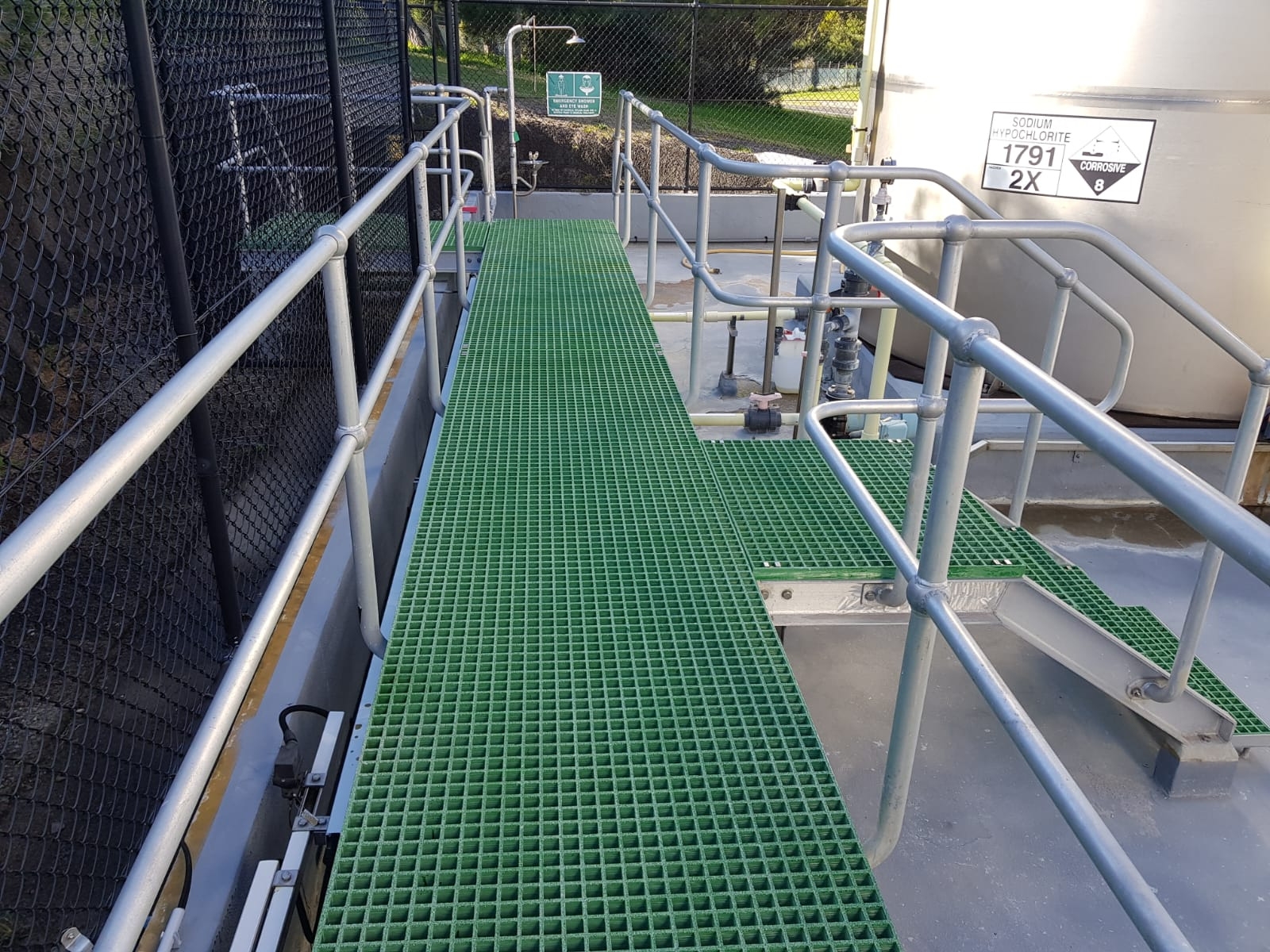
25 Apr 2026
What is FRP Grating? What are the advantages of FRP Grating? What are the properties of it? What field applications can FRP Grating be used for? In this article, we will answer these questions and provide you with a comprehensive understanding of FRP Grating.
Read More →